Shells, Scutes, and Scales: Florida’s Native Reptiles

By Anika Schmid 

Pelican Harbor Seabird Station’s Speaker Series “Shells, Scutes & Scales: Husbandry Care of Native Reptile Species at Frost Science” was held on February 12, 2025. The event was hosted by Helen Bradley, senior terrestrial biologist at the Phillip and Patricia Frost Museum of Science.

Bradley was a PHSS volunteer for six and a half years before joining the Frost Science team in 2022 as their herpetologist. She is now the senior terrestrial biologist, as she continues to care for the reptiles while also overseeing the birds.

Reptiles are complex, vital parts of our current ecosystem. Bradley shared lesser-known facts about reptiles and their care. She provided personal anecdotes about the native Florida reptiles she has worked with during her time at Frost. 

All About Reptiles

Reptiles are cold-blooded, known as ectotherms. They need to be out in the sunshine to gain body warmth, unlike mammals and birds, which make their own body warmth. If the reptile is too hot, they need to find a shady place or burrow to cool down. These adaptations enable them to survive on far less food since they do not need the calories from food to make body heat. Reptiles are very resilient and can endure harsh conditions and extended periods without food, a trait that has contributed to their evolutionary success for over 300 million years.
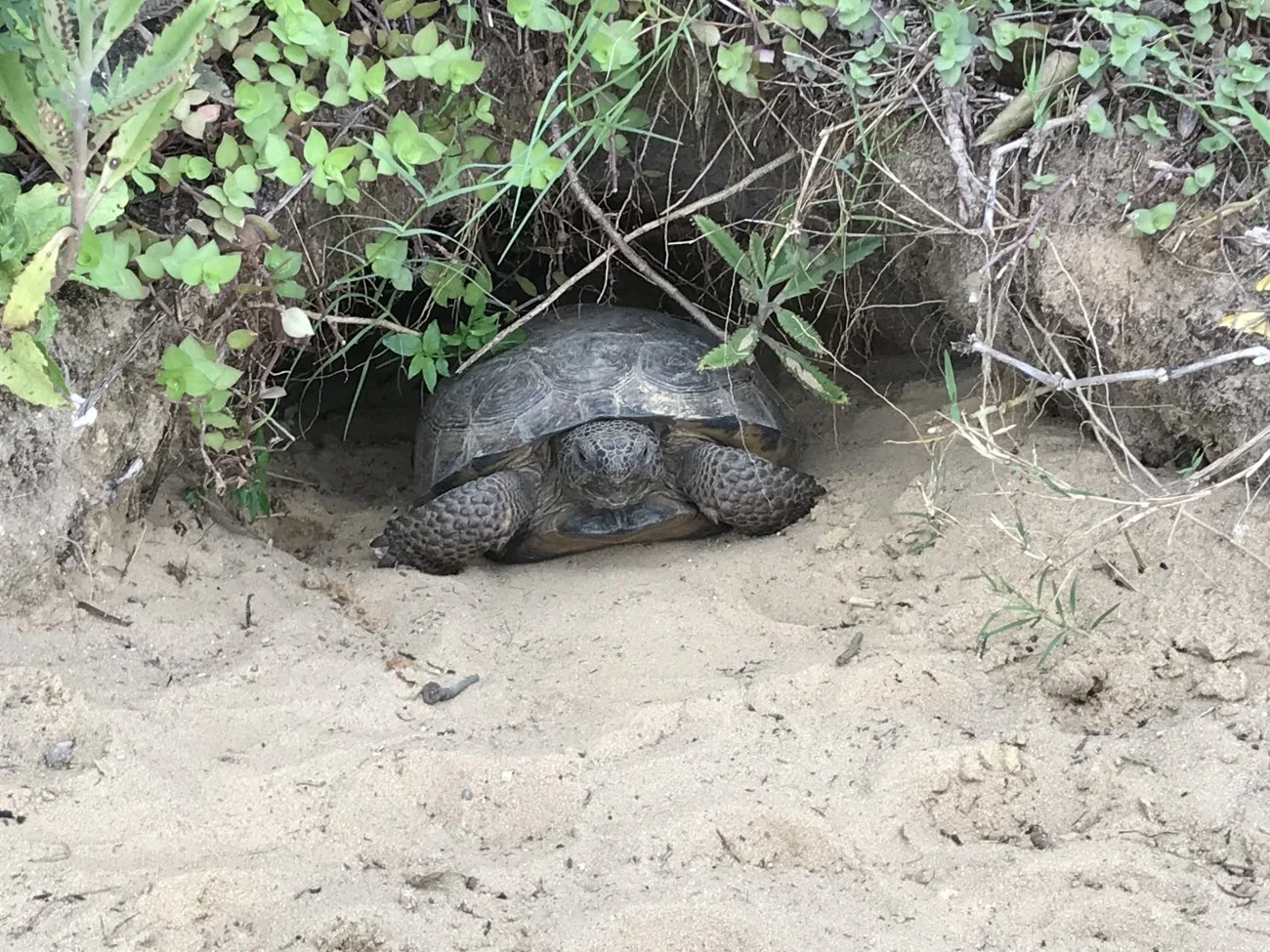
Gopher Tortoise in a burrow entrance at Merritt Island National Wildlife Refuge by James Lyon.

Gopher Tortoise in a burrow entrance at Merritt Island National Wildlife Refuge by James Lyon.

Gopher Tortoise

Gopher Tortoises are a keystone species, so they are a critical organism that has a disproportionately large impact on their environment. They play a critical role in maintaining the structure of an ecological community. Up to 350 species utilize the Gopher Tortoise burrow, including other reptiles. Their burrows maintain a stable temperature year-round, providing cool during hot summers and warmth during winters. Burrows can stretch over 40 feet long and about 10 feet deep. 

Gopher Tortoises have strong, elephant-like back legs, while their front legs are covered in scales. Their front feet are shaped like shovels, which is great for digging burrows. They also use their legs to dig depressions in the ground to catch and drink rainwater to stay hydrated even when it is dry. 

The shells of Gopher Tortoises can change color. When it is hot, their shells will lighten to reflect the heat. Their shells are darker when they are cold, allowing them to absorb more heat from the sun. This subtle shift in pigmentation helps Gopher Tortoises manage body temperature with precision. 

Gopher Tortoises have a very slow metabolism, like many reptiles, which allows them to survive long periods without food or water. They primarily eat grasses, fruits, and flowers, as well as over 300 species of plants. Similar to other species, Gopher Tortoises disperse seeds in their fecal matter. 

In 2024, Pelican Harbor Seabird Station treated 11 Gopher Tortoises, which are protected as a state-designated threatened species in Florida. The Florida Fish and Wildlife Conservation Commission (FWC) grants you permission to move a Gopher Tortoise if they are crossing a busy road. Put the tortoise in the same direction it was headed. Do not move the Gopher Tortoise to another location or put the tortoise in your car, since this constitutes illegal possession.

Box Turtle

A box turtle may live in the same one-mile square area. This species should never be relocated due to their small home range. Box turtles generally live for about 25 to 35 years, although some have been known to survive for over a hundred years.

Their shells are not just protective barriers; they are living regenerative structures. Box turtles can heal minor shell damage over time. They possess a hinged shell, which allows them to completely close themselves from predators by pulling all of their limbs — head, legs, and tail — into their shell. Their shell is made up of a combination of scales and bones. A box turtle’s shell includes the ribcage, and almost everything is fused together, adding to its strength.

Box turtles can travel about 55 yards a day on average. They can find their way home from strange areas as long as the turtle is not too far away. If you find a turtle on the road, pick them up and put them on the other side of the road. Always put the turtle in the same direction they were facing. 

Crocodilian: Alligator and Crocodile

Crocodilians are the apex predators of the reptile world. Florida has two species: the American Alligator and the American Crocodile. South Florida is the only place in the world where both live in close proximity.

Alligators and crocodiles are often confused with each other, but there are many easy ways to tell the two apart. Alligators have a U-shaped snout while crocodiles have a V-shaped snout. Crocodiles live longer, are larger, heavier, and have a stronger bite force. Male crocodiles can grow to 20 feet. Female alligators can grow to 10 feet. Alligators stop growing between 20 and 30 years old, while crocodiles continue to grow throughout their lives. The weight of a Saltwater Crocodile’s head is 440 pounds. 

Alligators and crocodiles regrow thousands of teeth throughout their lifetime. At any given time, they can have between 60 and 80 teeth. Their tongue is fused into their jaw, so they must tilt their head back to swallow their food. Crocodiles produce the strongest gastric juices known in the animal kingdom, enabling them to digest tough materials like bones, hooves, and shells of turtles. 

Alligators can effortlessly stay afloat and are built for the water. Their muscular and powerful tails help them swim efficiently. Alligators have large lungs and can move their lungs further to the back of their body to help them dive. They move their lungs forward to come up out of the water. 

In comparison, crocodiles have a harder time staying afloat because they are heavier and have a narrower body, making them less buoyant. They have a valve in the back of their mouth that seals the throat off from air and water. Crocodiles have a higher tolerance for lactic acid buildup in their muscles. This allows them to hold their breath for longer periods than the alligator, and crocodiles can swim more extended distances underwater.
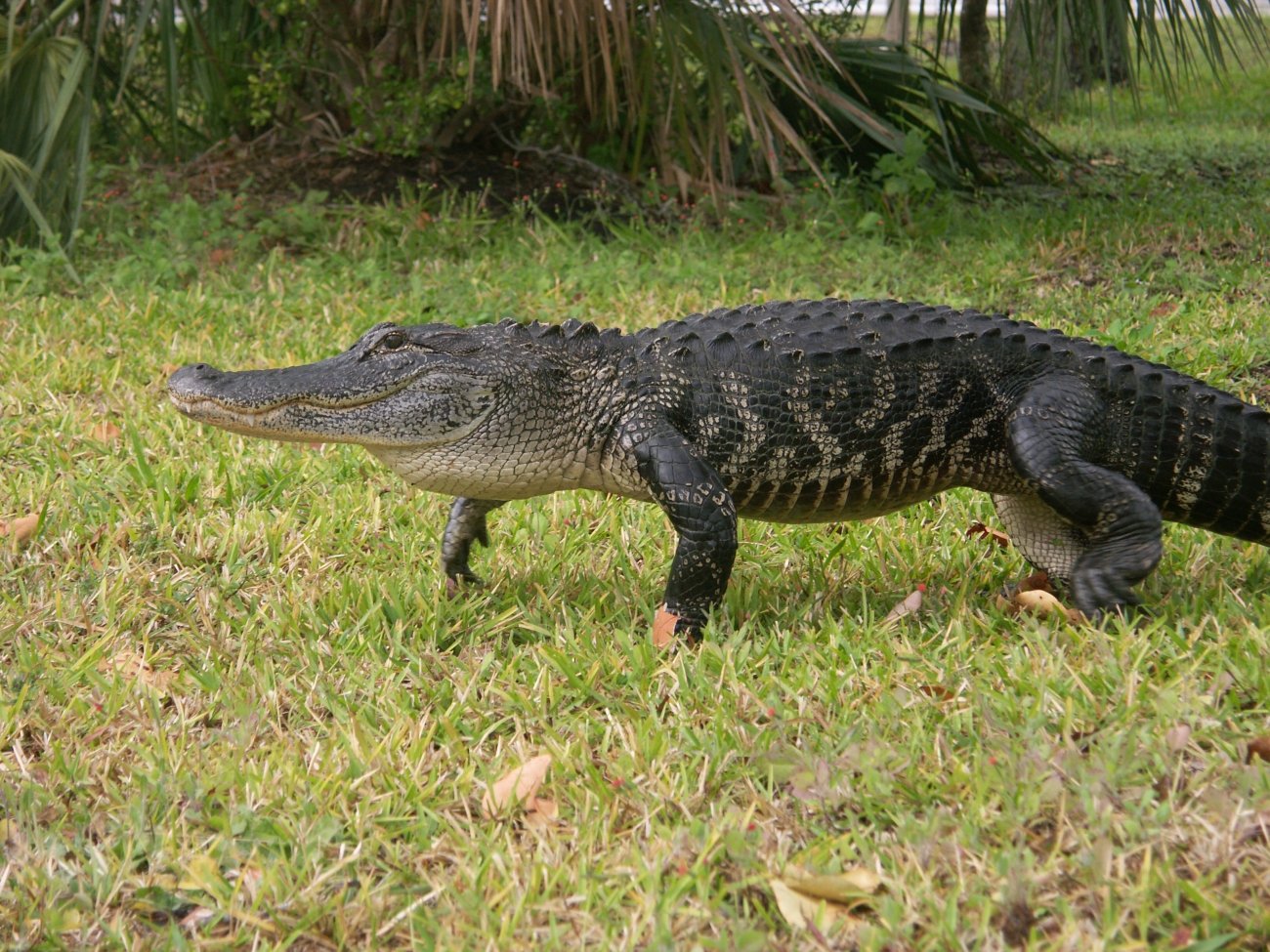

American Alligator at J. N. “Ding” Darling National Wildlife Refuge by USFWS.

American Alligator at J. N. “Ding” Darling National Wildlife Refuge by USFWS

Florida’s Alligators

Florida has an estimated population of 1.3 million alligators of every size. Since Florida’s human population has grown significantly, there has been an increase in waterfront homes and water-related activities. As a result, the frequency of human-alligator interactions can increase.

Please follow these safety tips from the FWC when encountering alligators.

  • Keep a safe distance if you see an alligator. 

  • Never feed an alligator. This is illegal and dangerous. A fed alligator can learn to associate people with the availability of food, leading them to become a nuisance and need to be removed from the wild.

  • Keep pets on a leash and away from the water’s edge. Pets often resemble the natural prey of alligators.

  • Swim only in designated swimming areas during daylight hours. Do not swim with your pet. Alligators are most active between dusk and dawn. 

If you’re concerned about an alligator, call the FWC’s toll-free Nuisance Alligator Hotline 866-FWC-GATOR (866-392-4286).
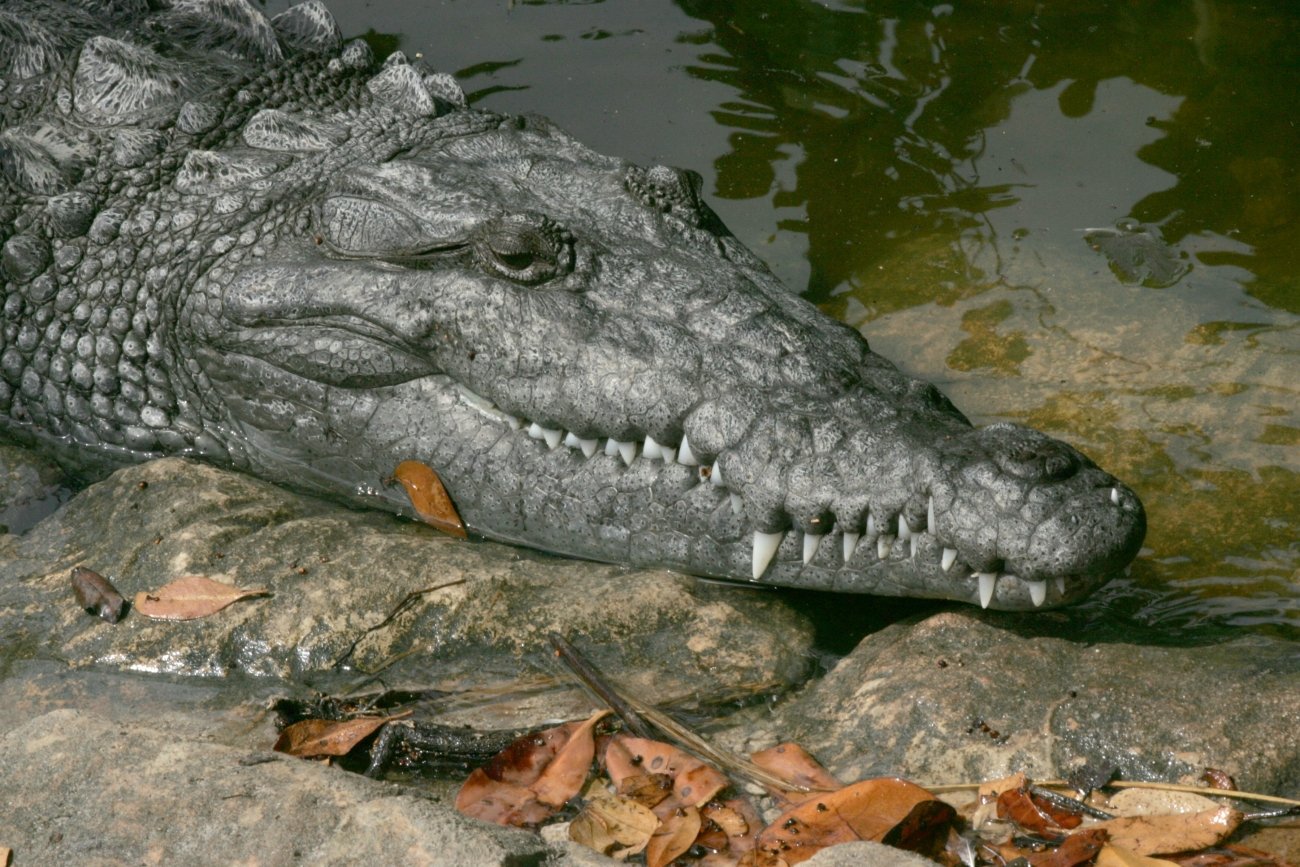
American Crocodile at Everglades National Park by Rodney Cammauf.

American Crocodile at Everglades National Park by Rodney Cammauf.

Florida’s Crocodiles

Florida is the only place in the United States where people can see American crocodiles in the wild. American Crocodiles were once listed as endangered in 1975, but the numbers have recovered from a few hundred to 2,000 adult crocodiles today.

The presence of a crocodile is not a reason for immediate concern. Often, it is best to leave the crocodile alone. Please follow these safety tips from the FWC when encountering crocodiles.

  • Leave crocodiles alone. Killing, harassing, or possessing crocodiles is prohibited by state and federal law.

  • Never feed crocodiles. This is illegal. Fed crocodiles may become accustomed to people and may be more likely to become a nuisance.

  • Keep pets a safe distance from water that may contain crocodiles. Do not allow pets to swim, exercise, or drink this water. Cats and dogs resemble the natural prey of crocodiles, so they are more susceptible to being bitten by crocodiles when in or near the water. 

  • Separate your family and pets from crocodiles with fencing or other barriers. 
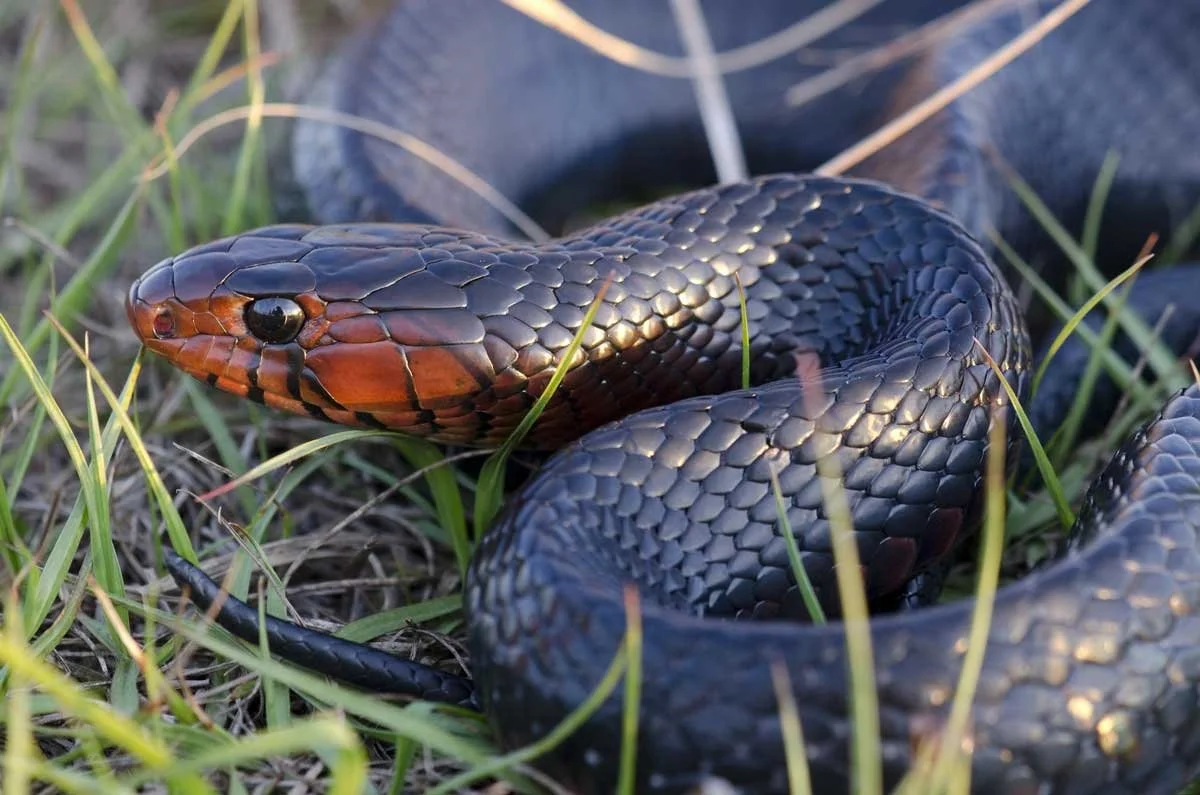
Eastern Indigo Snake in the grass by USFWS.

Eastern Indigo Snake in the grass by USFWS.

Eastern Indigo Snake

Eastern Indigo Snakes are the longest snake native to the United States, reaching 8 feet. They have iridescent, blue-black scales that shimmer under sunlight. 

This species is non-venomous but preys on anything they can overpower, such as mammals, small birds, fish, amphibians, and even other snakes. These snakes use their large size and powerful jaws to attack and eat prey. Eastern Indigo Snakes are immune to the venom of North American Rattlesnakes.

Eastern Indigo Snakes are federally protected as a threatened species in Florida. They are vulnerable due to habitat loss, fragmentation, and the pet trade. These snakes are one of the species that utilize Gopher Tortoise burrows to shelter from rain, heat, or cold weather. Eastern Indigo Snakes fall prey to hunters looking to flush out rattlesnakes in those burrows. 

FWC is looking to learn more about the Eastern Indigo Snakes, as they are a federally threatened species. Please report sightings through the Florida Rare Snake Registry for any of the following snakes: Eastern Indigo Snake, Southern Hognose Snake, Florida Pine Snake, Short-Tailed Kingsnake, or Rainbow Snake.

Identifying Snakes

There is no easy way to distinguish between non-venomous snakes and venomous snakes. Most non-venomous species have a rounded or spoon-shaped head, but there are exceptions like the venomous Coral Snake. Brown Water Snakes have a triangular head, but they are not venomous. Some Milk Snakes have a striking resemblance to the venomous Coral Snake, making them vulnerable to being killed by scared humans. Don’t rely on color-based rhymes or get close to a snake’s head to determine if it is venomous; move away from the snake.
What To Do When You Find a Baby Squirrel

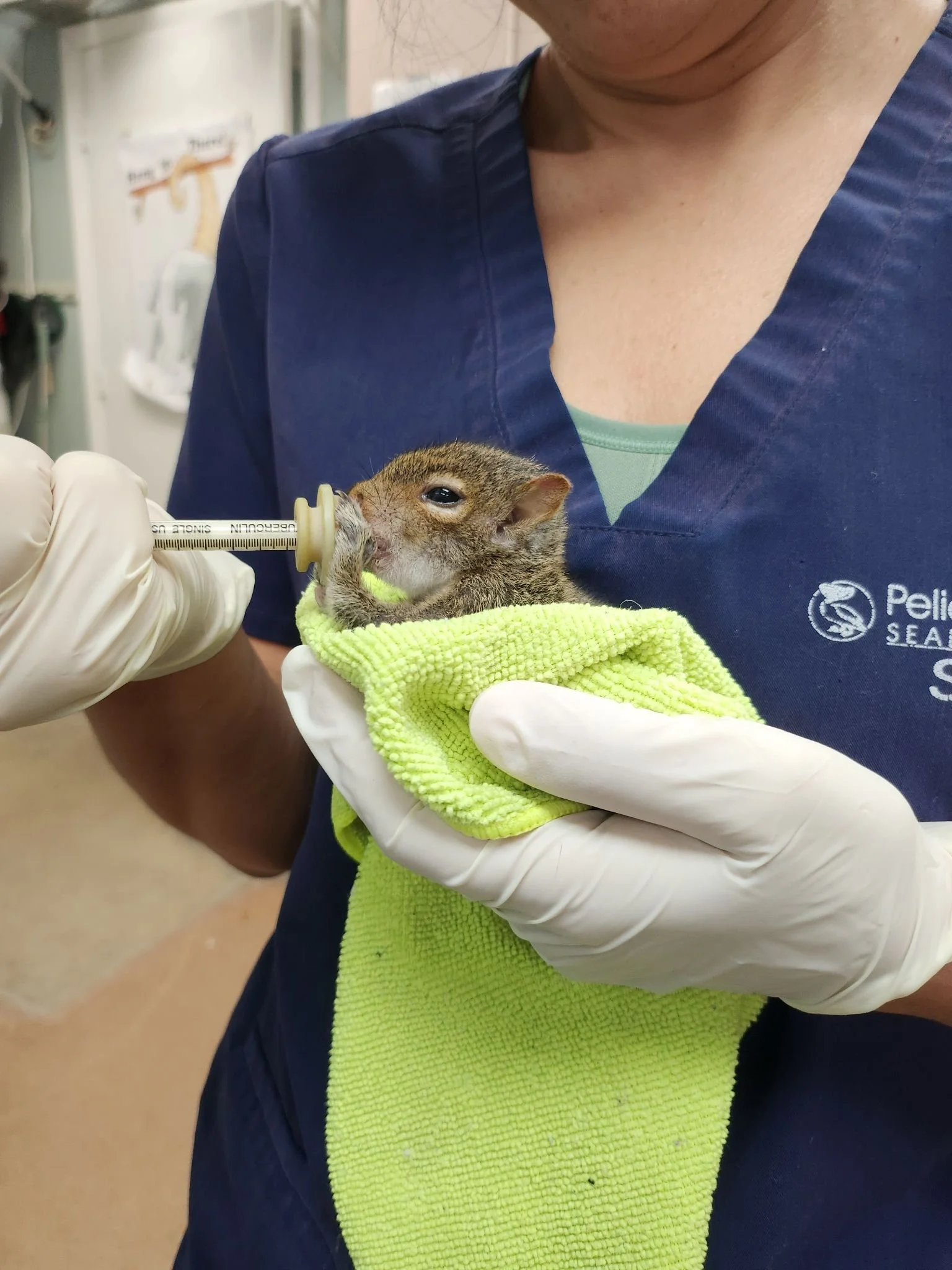
A baby squirrel held in the hands of a PHSS staff member.

A baby squirrel held in the hands of a PHSS staff member.

It can be easy to assume that a baby squirrel has been abandoned or orphaned, but often these squirrels may just need some help reuniting with their parents. Follow the steps below to determine if the baby squirrel you found needs to be brought into care at a local wildlife rehabilitation center.

Pelican Harbor Seabird Station is open every day from 9 AM to 5 PM. We have 24-hour drop-off cages for rescues outside of our business hours. Call our wildlife hotline at (305) 751-9840 for additional assistance.

Reminders for Handling Animals

  • Never feed or give water to an injured, sick, or orphaned animal. Feeding or providing water to animals, especially babies, can lead to serious medical complications.

  • If you have the animal contained, make sure it is in a comfortable box with air holes. Contained wildlife should be kept in a dark, quiet place with no human interaction.

  • Stress is a major cause of death for injured wild animals. An animal that seems calm around you may actually be experiencing extreme stress. 

  • Wild animals are not accustomed to being handled by people or around loud talking, noisy children, or pets. Do not try to hold or pet them.

Determining the Baby Squirrel’s Condition 

A baby squirrel’s best chances of survival are with the mother. 

Place the baby in a dark, warm box and contact your local wildlife rehabilitation center if you find a baby squirrel affected by the following:

  • visible wounds or injury

  • bleeding

  • shivering

  • vomiting

  • attacked by a cat or dog

  • cold and wet

  • covered in flies or ants

Determining the Age: Baby Squirrel or Juvenile Squirrel

If the squirrel has a bushy tail and a body longer than six inches, it is a juvenile squirrel. It should be left alone or placed on the nearest tree if it is approaching people.

If the squirrel does not have a bushy tail and body longer than six inches, follow these steps:

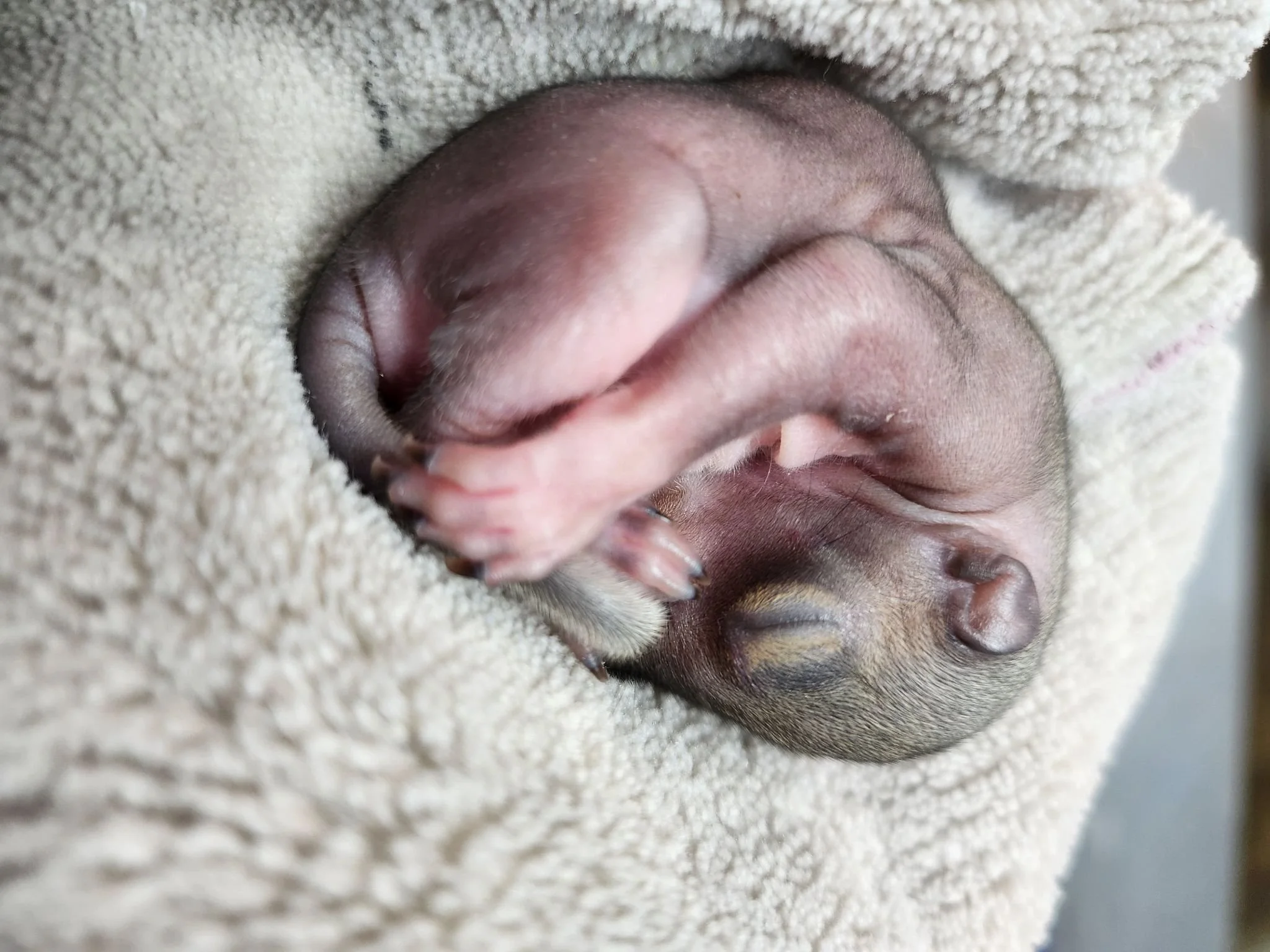
A pink baby squirrel with little hair and closed eyes.

A pink baby squirrel with little hair and closed eyes.

  1. Place the baby in a small open box, if it is cold, do so with a gently warm water bottle or rice sock. Ensure that the box has holes for drainage in case of rain, and do not use cardboard which may soak and fall apart.

  2. Place the box at the base of the tree nearest to where you found the squirrel.

  3. If there are cats or other animals around, you may fasten the box above the ground at chest or eye level, either by nestling it between branches or strapping it to the tree trunk with string or bungee cords.

  4. Observe from a distance for the next 12-24 hours.

If the mother returns, you can leave the area as the baby is okay. If the mother does not return, place the baby in a dark, warm box and contact your local wildlife rehabilitation center.


Finding a Local Wildlife Rehabilitator

To find a wildlife rehabilitator in your area, check the Humane World for Animals directory

If you are unable to reach a wildlife rehabilitator, call your state wildlife agency or a wildlife veterinarian. If you are unable to reach any of these, see the instructions below for rescuing baby squirrels.


Steps for Rescuing Baby Squirrels

Only adults should rescue baby mammals. Before rescuing adult mammals, seek guidance from a wildlife rehabilitator.

The steps below are adapted from Healers of the Wild: People Who Care for Injured and Orphaned Wildlife by Shannon K. Jacobs. 

  1. Prepare a container. Place a soft cloth on the bottom of a cardboard box or cat/dog carrier with a lid. If it does not have air holes, make some. For smaller animals, you can use a paper sack with air holes punched in. 

  2. Protect yourself by wearing gloves if possible. Some animals may bite or scratch to protect themselves, even if sick. Squirrels can pass diseases to humans and pets, along with parasites such as fleas, mites, or ticks.

  3. Cover the squirrel with a light sheet or towel.

  4. Gently pick up the squirrel and put it in the prepared container. 

  5. Warm the squirrel if it’s cold out or if the animal is chilled. Put one end of the container on a heating pad set on low. You could also fill a zip-top plastic bag, a plastic soft drink container with a screw lid, or a rubber glove with hot water. Wrap the warm container with a cloth and put it next to the squirrel. Make sure the container does not leak or the squirrel will get wet and chilled. 

  6. Tape the box shut or roll the top of the paper bag closed. 

  7. Note the exact location where you found the squirrel. This will be very important for release. 

  8. Keep the squirrel in a warm, dark, quiet place away from children and pets. Leave it alone; don’t handle or bother it. Don’t give the squirrel food or water unless you are directed to do so by a licensed wildlife rehabilitator. Different species require different diets, and improper feeding can injure the baby and cause more harm than good.

  9. Contact a wildlife rehabilitator, state wildlife agency, or wildlife veterinarian as soon as possible. Don’t keep the squirrel at your home longer than necessary. Keep it in a container and do not let it loose in your house or car. 

  10. Wash your hands after contact with the squirrel. Wash anything the squirrel was in contact with — such as a towel, jacket, blanket, or pet carrier — to prevent the spread of diseases and/or parasites to you or your pets. 

  11. Get the squirrel to a wildlife rehabilitator as soon as possible. The faster the squirrel is cared for by a permitted rehabber, the better the chances for its survival.

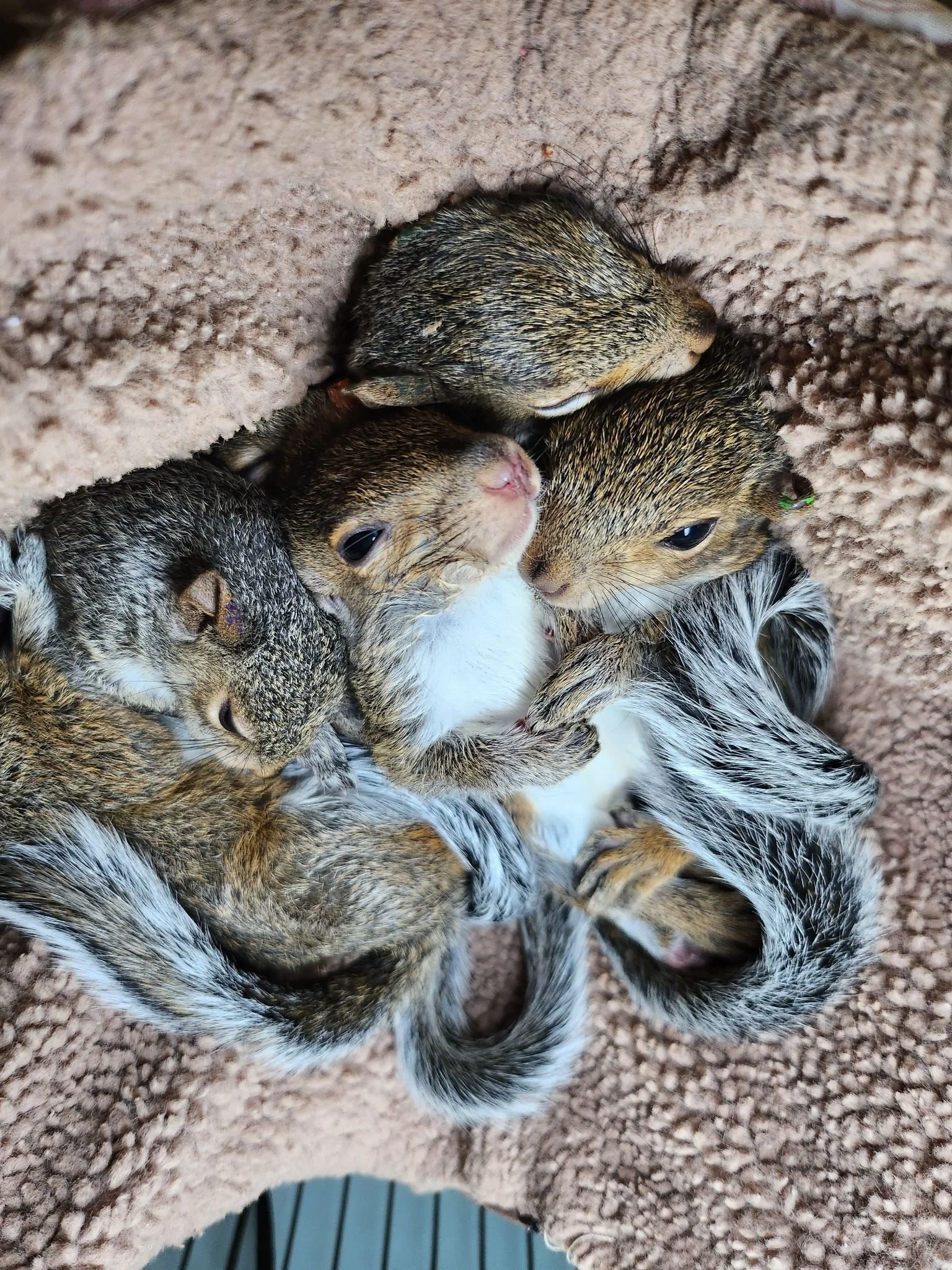
Four squirrels in a pile.

Four squirrels in a pile.

Call PHSS at (305) 751-9840 to bring a patient to us or be directed to your nearest wildlife center. We are open every day from 9 AM to 5 PM. We recommend that you keep babies at home overnight and bring them in the next morning.

What To Do When You Find a Baby Bird

By Anika Schmid 

It can be easy to assume that a baby bird has been abandoned or orphaned, but often these birds may just need assistance getting back into their nest. Follow the steps below to determine if the baby bird you found needs help being renested or needs to be brought into care at a local wildlife rehabilitation center. 

Pelican Harbor Seabird Station (PHSS) is open every day from 9 AM to 5 PM. We have 24-hour drop-off cages for rescues outside of our business hours. Call our wildlife hotline at (305) 751-9840 for additional assistance.

Reminders for Handling Animals

  • Never feed or give water to an injured, sick, or orphaned animal. Feeding or providing water to animals, especially babies, can lead to serious medical complications.

  • If you have the animal contained, make sure it is in a comfortable box with air holes. Contained wildlife should be kept in a dark, quiet place with no human interaction.

  • Stress is a major cause of death for injured wild animals. An animal that seems calm around you may actually be experiencing extreme stress. 

  • Wild birds are not accustomed to being handled by people or around loud talking, noisy children, or pets. Do not try to hold or pet them.

Determining the Bird’s Condition

A baby bird’s best chances of survival are with the mother. First, call your local wildlife center to ensure the bird you found is a baby. 

If you find a baby bird you think is abandoned, observe it for about an hour. If there is no sign of the parents, contact a local wildlife rehabilitator for advice.

Place the baby in a dark, warm box and contact your local wildlife rehabilitation center if you find a baby bird affected by the following:

  • visible wounds or injuries

  • unable to flutter wings

  • bleeding

  • wings drooping unevenly

  • weak or shivering

  • attacked by a cat, dog, or other animal

  • cold and wet

  • covered in flies or ants


Uninjured Fledglings

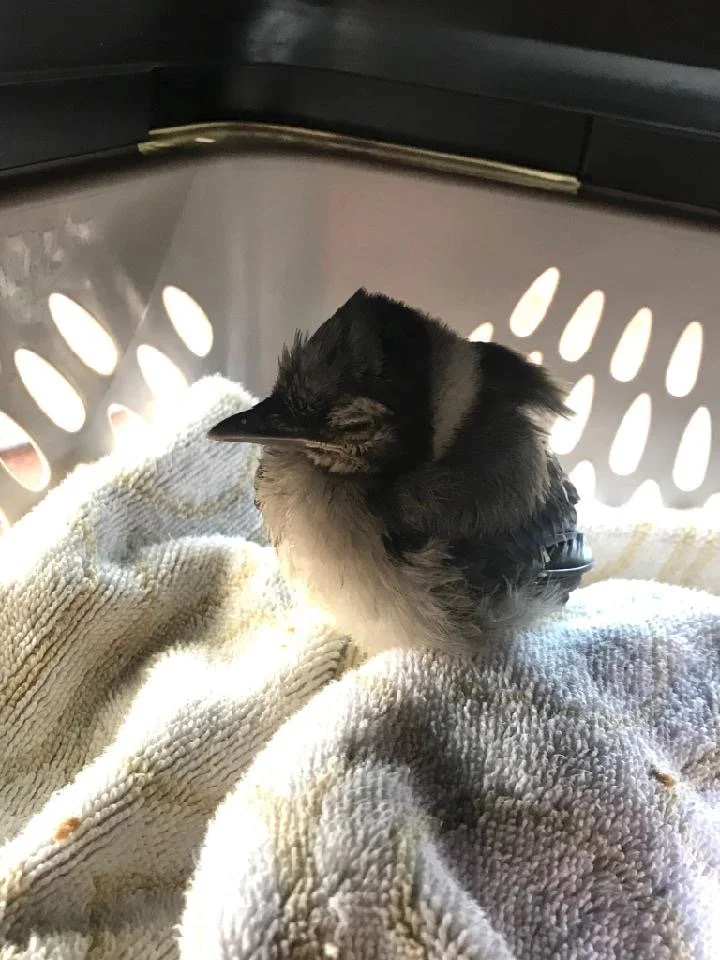
A Blue Jay fledgling on top of a towel in a laundry basket.

A Blue Jay fledgling on top of a towel in a laundry basket. 

If the bird is fully feathered and hopping on the ground, this is a fledgling. It should be left alone if it is not hurt or sick. The parents are caring for it and teaching it to fly since birds learn from the ground up. The fledgling’s parents will be back soon to feed it. 

If the uninjured fledgling is not safe from cats, dogs, and people, put the bird in bushes or on a nearby tree limb. Watch from a distance. If the parents are nearby, you can leave the area because the fledgling is okay. If the parents are not nearby, call a wildlife rehabilitator.

Renesting Process for Baby Birds

If the baby bird is not injured or sick, the next best option is to renest. 

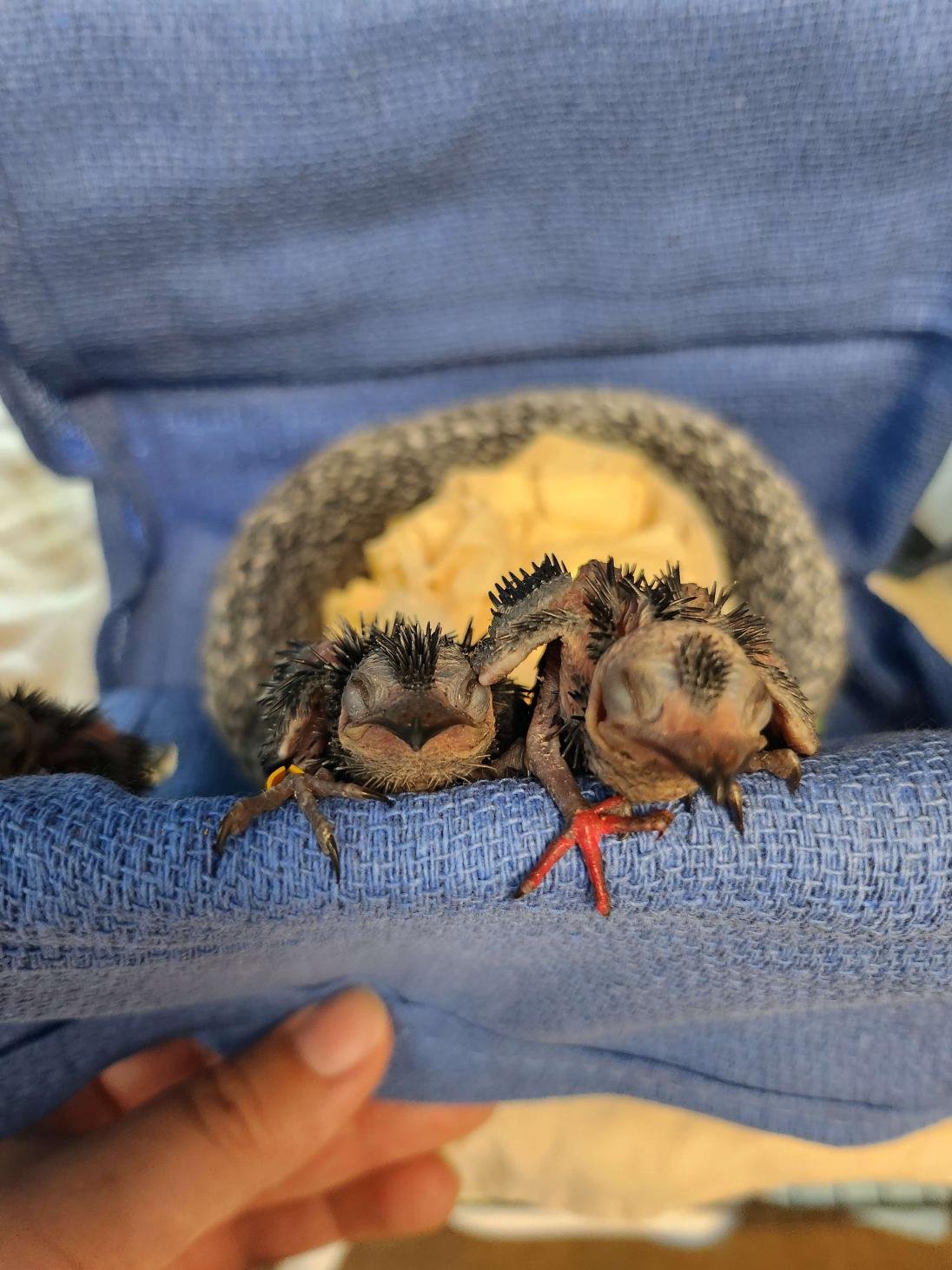
Two baby Chimney Swifts with eyes closed.

Two baby Chimney Swifts with eyes closed.

If the baby bird is pink, not fully feathered, and not hopping around, it is a nestling and is too young to be out of the nest. If you can access the original nest, gently place the bird back in it. You can use kitchen or garden gloves for this process. 

It is a myth that mother birds will not return after you have touched their baby. Your scent will not scare away the mother.


If the original nest is destroyed or too high to reach, follow the steps shown in our video to create a substitute nest:

  1. Use a small basket or poke holes in the bottom of a small container and line it with grass.

  2. Use rope or zip ties to secure it to a tree limb where it will be protected from the elements. Return the baby bird to the new nest.

  3. Observe from a distance for the next 12 hours to ensure the parents come back to the nest.

If the mother does not return, place the baby in a dark, warm box and contact your local wildlife rehabilitation center.

Finding a Baby Duck, Goose, Quail, or Killdeer

If you know the mother of a baby duck, goose, quail, or Killdeer is dead or if the baby is injured, call a wildlife rehabilitator right away. If the baby is separated from the mother and you know where she is, place the baby close by so she can hear it. Watch from a distance. 

If the mother is not found or does not claim the baby within an hour, call a wildlife rehabilitator. If you cannot reach one, rescue the baby by following the section “Steps for Rescuing Baby Birds” below.

Finding a Local Wildlife Rehabilitator

To find a wildlife rehabilitator in your area, check the Humane World for Animals directory. The U.S. Fish & Wildlife Service has a map of bird rehabilitator locations.

If you are unable to reach a wildlife rehabilitator, call your state wildlife agency or a wildlife veterinarian. If you are unable to reach any of these, see the instructions below for rescuing baby birds.

Steps for Rescuing Baby Birds

Only adults should rescue baby birds. Children who find a baby bird should not touch it; instead, they should immediately inform an adult. Before rescuing adult birds, seek guidance from a wildlife rehabilitator. 

The steps below are adapted from Healers of the Wild: People Who Care for Injured and Orphaned Wildlife by Shannon K. Jacobs. 

  1. Prepare a container. Place a clean, soft cloth with no strings or loops on the bottom of a cardboard box or cat/dog carrier with a lid. If it does not have air holes, make some. For smaller birds, you can use a paper sack with air holes.

  2. Protect yourself by wearing gloves if possible. Some birds may stab with their beaks, slice with their talons, and slap with their wings to protect themselves, even if sick. Birds commonly carry diseases and have parasites such as fleas, lice, or ticks. 

  3. Cover the bird with a light sheet or towel. 

  4. Gently pick up the bird and put it in the prepared container. 

  5. Tape the box shut or roll the top of the paper bag closed. 

  6. Note the exact location where you found the bird. This may be important for release. 

  7. Keep the bird in a warm, dark, quiet place away from children and pets. Leave the bird alone; don’t handle or bother it. Don’t give the bird food or water unless you are directed to do so by a licensed wildlife rehabilitator. Different species require different diets, and improper feeding can injure the baby and cause more harm than good. 

  8. Contact a wildlife rehabilitator, state wildlife agency, or wildlife veterinarian as soon as possible. Don’t keep the bird at your home longer than necessary. Keep it in a container and do not let it loose in your house or car.

  9. Wash your hands after contact with the bird. Wash anything the bird was in contact with — such as a towel, jacket, blanket, or pet carrier — to prevent the spread of diseases and/or parasites to you or your pets. 

  10. Get the bird to a wildlife rehabilitator such as Pelican Harbor Seabird Station as soon as possible. The faster the bird is cared for by a permitted rehabber, the better the chances for its survival. 

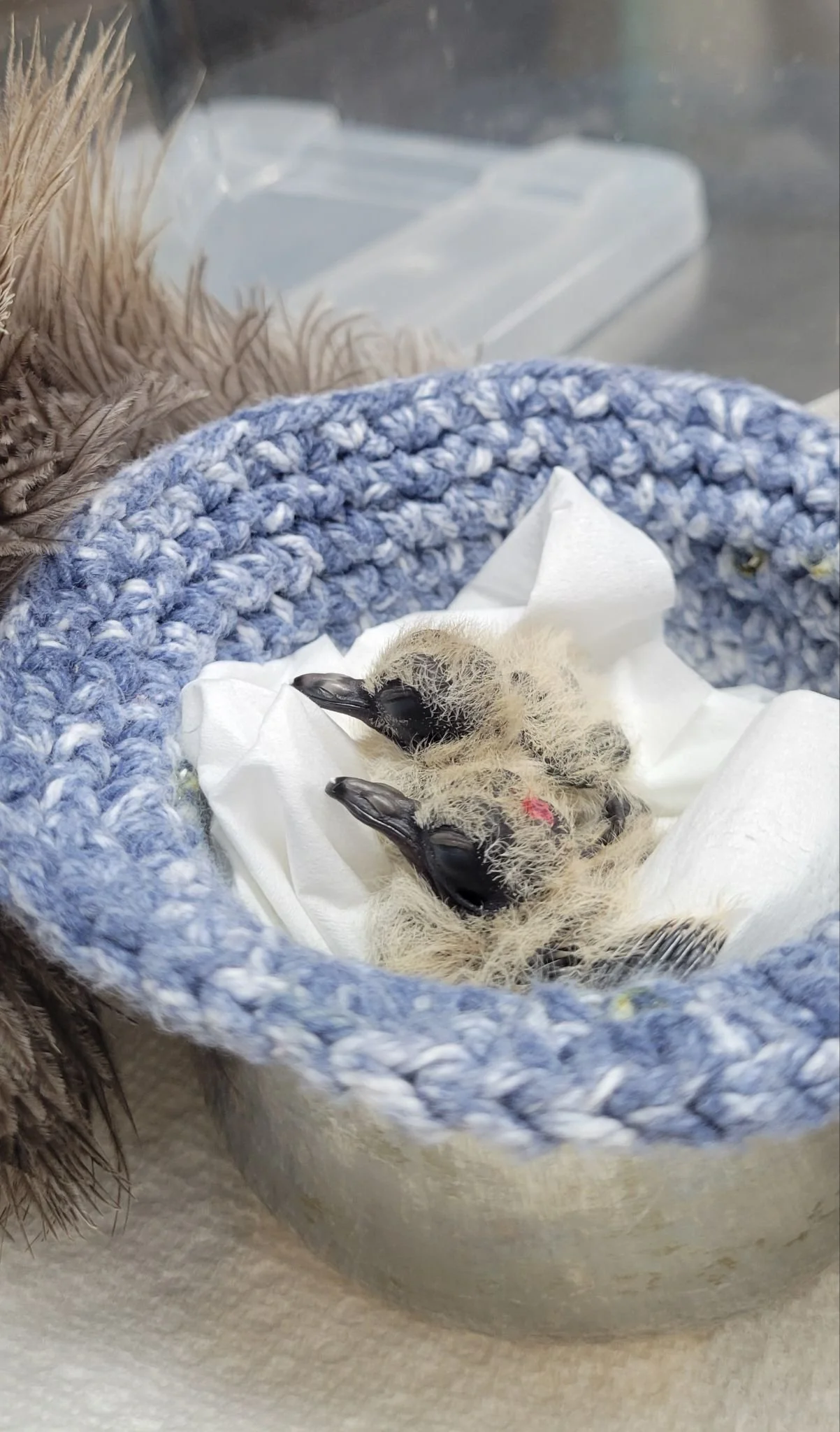
Two baby Mourning Doves.

It is illegal to keep most wild birds as pets. It’s against the law in most states to keep wild birds if you don’t have permits, even if you plan to release them. Any wild bird you encounter should be left alone or turned over to a licensed wildlife rehabilitator. 

Call PHSS at (305) 751-9840 to bring a patient to us or be directed to your nearest wildlife center. We are open every day from 9 AM to 5 PM. We recommend that you keep babies at home overnight and bring them in the next morning.

All About Sea Turtles: Conservation Efforts and Strategies

By Anika Schmid 

Pelican Harbor Seabird Station’s Speaker Series “All About Sea Turtles” was held on September 11, 2024. The event was hosted by sea turtle biologist Emily R. Bernfeld and lighting program coordinator Sophia Brown from the Miami-Dade County Sea Turtle Conservation Program (STCP). These biologists shared information about how they monitor sea turtle nesting sights and report disoriented hatchlings to the state.

Nearly all sea turtles are listed as critically endangered, endangered, or threatened. Human activities influence many of the challenges that sea turtles face. While Pelican Harbor does not have the proper facilities to care for sea turtles, following the conservation strategies of the STCP and the Florida Fish and Wildlife Conservation Commission (FWC) can help protect the sea turtle population and marine ecosystems. 

Miami-Dade County’s Sea Turtles 

March to October is the nesting season in Miami-Dade County. There are seven species of sea turtles: Kemp’s Ridley, Olive Ridley, Loggerhead, Leatherback, Green, Hawksbill, and Flatback. Loggerhead, Green, and Leatherback are the only three sea turtles that nest in Miami-Dade County, as Kemp’s Ridley and Hawksbill pass by the area.

Loggerhead

Loggerhead Sea Turtles are the most common nester in Miami-Dade County, accounting for about 95% of the nesting population. They nest from mid-April to early September. They typically weigh up to 200 to 400 pounds. Loggerheads are known for their large skull; they need a big jaw to crush conch shells and crustaceans. The diet of adults consists of shellfish and crustaceans.

A nesting Loggerhead Sea Turtle in the sand.

Nesting Loggerhead Sea Turtle. All sea turtle activities in Miami-Dade County are conducted by authorized personnel under FWC MTP-25-150.


Green

Green Sea Turtles make up about 5% of nesting turtles in Miami-Dade County. They nest from mid-May to September. They can weigh from 300 to 500 pounds, making them the biggest hard-shelled sea turtle. Despite weighing more than Loggerheads, Green Sea Turtles have smaller heads. Their adult diet consists of seagrasses and algae. The fat of Green Sea Turtles turns green, which is how they got their name. The character Crush from the Pixar animated film Finding Nemo is a Green Sea Turtle.

Leatherback

Leatherback Sea Turtles make up about 5% of nesting turtles in Miami-Dade County. They nest from mid-March to June. Weighing 1,200 to 2,000 pounds, Leatherbacks are the largest sea turtle in the world. They are the closest living relative to the extinct Archelon. Leatherbacks are the only sea turtles without a hard shell, and they dive deep to catch big jellyfish, which is their main diet. Their papillae help prevent the prey they are eating from escaping.

Leatherback Sea Turtle in the sand with the ocean behind.

Leatherback Sea Turtle. All sea turtle activities in Miami-Dade County are conducted by authorized personnel under FWC MTP-25-150.


Sea Turtle Conservation

Conservation is the protection of something from change or loss. Sea turtles are a keystone species, meaning they support ecosystem function and balance. Sea turtles transport nutrients to different areas, which makes them thrive and increases biodiversity. 

Kemp’s Ridley and Hawksbill are critically endangered. Green Sea Turtles are endangered. Loggerhead, Leatherback, and Olive Ridley are threatened. There is insufficient information on the conservation status of Flatback Sea Turtles, as they are located in Australia. 

STCP’s Role in Sea Turtle Conservation

Miami-Dade County STCP works within the EECO (Environmental, Education, and Conservation Outreach) division for the Miami-Dade County Parks, Recreation, and Open Spaces Department. Emily Bernfeld and Sophia Brown are authorized sea turtle personnel under an FWC permit.

From March 1 to October 31, the nesting season, STCP staff survey 19 miles of beaches every morning — from Golden Beach to Key Biscayne. They mark off nests with stakes and collect data for FWC and other federal agencies. A few days after a sea turtle nest hatches, STCP staff will excavate the nest and count the number of eggs that hatched and those that remain unhatched.

Only one in a thousand sea turtle hatchlings makes it to adulthood. There are many ways for ordinary people to protect sea turtles and marine life.

Prevent Boat Strikes

Boat strikes are the number one cause of strandings in Miami-Dade County. Strandings occur when a sea turtle is not able to swim properly in the ocean. Propellers can instantly kill sea turtles or cause severe paralysis. The spine of sea turtles is fused to the shell. When a boat hits the back of a sea turtle’s shell, it could break their ribs and puncture their lungs, causing them to drown. Positive buoyancy disorder, also called “bubble butt,” can occur when boat strikes create air pockets in their shell.

NOAA Fisheries advises the following to protect marine animals from boat strikes:

  • Follow all speed zones.

  • Always be alert.

  • Keep a distance of at least 100 yards from a sea turtle.

  • Wear polarized sunglasses to see marine animals better.

Avoid Single-Use Plastics

Single-use plastic breaks down into smaller pieces, known as microplastics, and causes marine life to choke or become sick. Microplastics and macroplastics are often ingested because they are mistaken for food by wildlife. Some examples of this are shopping bags, bottle caps, coffee cups, utensils, food wrappers, and straws. Use reusable items that can be washed instead of thrown away, like reusable cups and lunch boxes.

Dispose of Fishing Gear Properly

Sea turtles are constantly entangled or captured in fishing gear. A turtle excluder device (TED) has helped reduce the number of sea turtles caught via bycatch, the unintentional capture of non-target marine animals. Research suggests that using circle hooks instead of “J” hooks prevents sea turtle catches.

Reduce Artificial Lighting

Sea turtles follow the brightest horizon — the moonlight reflecting on the water. Human-made light sources can confuse sea turtles’ way-finding ability while on land. While sea turtles are crawling and confused by artificial light sources, they expend a lot of energy and are thus at a higher risk of dehydration, exhaustion, and death. Increased coastal development is a very large problem, especially in southeast Florida, since there are more light sources. 

Artificial light issues commonly affect hatchling sea turtles. Disorientation events occur when sea turtles are lost, confused, or do not make it to the ocean because of artificial lighting. Baby hatchlings are sometimes found in the morning, but other times they are not. STCP members are permitted to document these disorientation events and are required to find out what happened to every sea turtle track.

A small sea turtle hatchling in the sand, facing the ocean.

A sea turtle hatchling. All sea turtle activities in Miami-Dade County are conducted by authorized personnel under FWC MTP-25-150.


Artificial lights also disorient seabirds and migratory birds. It causes collisions, entrapments, strandings, groundings, and interference with navigation. The intensity and color of light have the potential to confuse birds. 

Most wildlife lights are recommended to be orange, amber, or red in color because these colors emit longer-wavelength lights, which are less disruptive to animals. Shorter-wavelength lights, such as those with white, blue, or green color, tend to be more disruptive to sea turtles and other wildlife.

People who live in beach units should abide by the following:

  • Close blinds at night (after 9 PM). Consider installing blackout curtains or window tinting. 

  • Shut off interior lights when not in use.

  • Keep exterior lights low, shielded, and long. This follows the FWC’s wildlife lighting criteria

  • Turn off phone flashlights when walking on the beach. Carry a red flashlight instead. 

  • Follow local lighting ordinances. Search for your municipality on Municode and look up “sea turtle.”

Use Reef-Friendly Sunscreen 

Reef-friendly sunscreens are formulated without harmful chemicals like oxybenzone and octinoxate, which have been linked to coral bleaching, DNA damage in coral, and disruption of marine ecosystems. Avoid the following ingredients: oxybenzone, octocrylene, octinoxate, parabens, avobenzone, and homosalate.

Be Mindful of Marine Life

While at the beach, make sure to keep your distance from any wildlife. Do not feed, pet, or do anything that could interfere. If you see any lethargic animals, contact your local authorized personnel.

Sea turtle nest cordoned off by wooden stakes and tape. A turtle-shaped sign reads that the nest has been symbolically adopted.

Miami-Dade County STCP Adopt-A-Nest Program. All sea turtle activities in Miami-Dade County are conducted by authorized personnel under FWC MTP-25-150.


Knock Down Sandcastles and Fill in Holes 

If sandcastles or holes block a hatchling’s way to the ocean, they could fall into the hole or get stuck and become very lethargic. Before leaving the beach, fill in holes and knock down sandcastles to decrease sea turtles’ vulnerability to exhaustion. 

Do Not Leave Anything Behind on the Beach 

Be sure that anything you take to the beach returns home, including trash, chairs, food, umbrellas, and towels. Any unnatural items on the beach can be a hazard for sea turtles. 

STCP works with beach vendors to ensure chairs are stacked properly, preventing hatchlings from getting lost. When nesting mothers hit obstacles like stacked chairs, their nesting attempts are obscured. STCP staff also report these incidents to the state. 

If You See a Stranded Sea Turtle 

Call the Miami-Dade County STCP stranding line (305) 310-3046 if you encounter a sick, injured, entangled, stranded, or dead sea turtle on the beach. If they cannot be reached, call the FWC 24-hour Wildlife Alert line: (888) 404-3922. Keep your distance and wait for an authorized individual to arrive or provide further instructions. 

To report poaching or vandalism, call the police or the FWC Wildlife Alert line at 1-888-404-3922

Overview of Pelican Harbor Seabird Station’s 2024 Data

by Anika Schmid

Rescuing Miami’s Native Wildlife” was held on January 15, 2025, and hosted by Yaritza Acosta, the Rehabilitation Manager at Pelican Harbor Seabird Station (PHSS). As part of our monthly Natural History Speaker Series, the presentation recapped our 2024 data, including the animals with the highest intakes and reasons for admission. The key trends from last year reveal the vital role that rehabilitation plays in wildlife conservation. This data is also available in the 2024 Annual Report.


2024 Intakes

In 2024, PHSS treated 2,476 patients from 148 species. We received approximately 7,817 calls from the public throughout the Miami area, with Miami Beach having the largest amount of intakes.


April was the month with the highest number of intakes, 292, because it was the peak month for the spring baby bird season. Most calls were for injured, orphaned, or kidnapped baby birds. October saw a spike of 266 patients admitted because of fall migrants. During this month, we often receive calls about animals that have been injured or are suffering from migration fatigue.


Intakes by Class

With 1,649 aves, 792 mammals, and 35 reptiles, every class had more intakes in 2024 than in the last two years. The most common type of avian was songbirds, with 745 intakes. Songbirds are the biggest order of birds and have the most subspecies. Baby bird season sees an influx of nests falling from trees and babies getting hurt. April and October were the months with the highest intakes of avians. Bird intakes were steady throughout 2024.

Alt text: The year 2022 had 1,417 aves, 674 mammals, and 25 reptiles. The year 2023 had 1412 aves, 766 mammals, and 31 reptiles. The year 2024 had 1,649 aves, 792 mammals, and 35 reptiles. 

Caption: Bar graph showing the number of aves, mammals, and reptiles from 2022 to 2024. The y-axis represents the number of intakes. 

The most prevalent patients were the Virginia Opossum (48.1%), Grey Squirrel (17.6%), Northern Mockingbird (12.4%), Blue Jay (11.8%), and Laughing Gull (10.1%). Of the 148 species treated in 2024, 14 were new species. The most notable was an Atlantic Puffin found by Miami Beach Fire Rescue lifeguards in February 2024.


Avians

The most common songbird was the Northern Mockingbird, with 146 admitted. These are a common songbird in South Florida, and many nests are disturbed during baby bird season. Laughing Gulls were the most common seabird, with 119 admitted. They are increasingly becoming more urbanized; more Laughing Gulls can be found by beaches, lakes, and small bodies of water. The most common raptor was the Eastern Screech Owl, with 69 admitted. Most of these owls were babies who fell out of trees or had their trees cut down. The most common shorebird was the White Ibis, as 68 were admitted. These shorebirds often suffered from weakness and trauma-related injuries. When looking for lizards on the side of roads, White Ibis are often hit by cars. 

Alt text: A baby Eastern Screech Owl being held by a human hand.

Caption: A baby Eastern Screech Owl.


Mammals

The most common mammals admitted were 566 Virginia Opossums and 207 Grey Squirrels. The intake of opossums has increased since 2023. These opossums usually come in groups. If a mother is hit by a car and has babies in her pouch, there could be ten baby opossums admitted that day. 


April and August were the months with the greatest mammal intakes. Squirrels have two breeding seasons: spring and fall. Opossums breed year-round, but there is sometimes an increase in the spring months.


Reptiles

PHSS receives relatively few reptile intakes — 31 in 2023 and 25 in 2022 — but there were 35 intakes in 2024. There is no pattern regarding reptile intakes by month, but there were six intakes in July 2024. Most reptile breeding seasons are in the spring, while the Cooter’s breeding season is year-round. Reptiles usually cross the road and get hit by a car. People often pick the reptiles up or move them, thinking something is wrong when they could have just helped the reptile cross the street.


The most common reptile was the Gopher Tortoise, with 11 admitted. These tortoises are federally protected and cannot be released until PHSS receives special permission from the Florida Fish and Wildlife Conservation Commission (FWC). The FWC lets us know where the tortoise can go, whether it is back in the wild or to a holding site, before the tortoise is ready for release. Gopher Tortoises do well, but they stay with PHSS for a long time as we wait for FWC instructions. 


Reasons for Admission

Trauma was the biggest reason for admission in 2024, with 949 intakes. This ranges from being hit by a car to being attacked by cats or dogs. The most common reason for trauma was 104 cat interactions. Miami has a lot of feral cats, and many people have their cats outside. These cats attack these animals and injure them. There were 79 intakes for physical trauma. In these cases, the animal will come in with wounds or signs of trauma, but we do not know exactly what happened to them. Window strikes, the cause for 56 intakes, happen frequently during migration. Many birds migrate at night and become disoriented by sound and light pollution, causing them to collide with walls and buildings.

Alt text: Before and after pictures of an ovenbird. In the before picture, the ovenbird’s eye and head are swollen, causing its eye to be half-shut. In the after photo, the swelling is gone and the ovenbird has an open eye.

Caption: An ovenbird that flew into a window and suffered bad trauma. His head and eyes were swollen and infected. He was on laser therapy, oxygen therapy, and medication supportive care. After a few days, his swelling went down dramatically. His eye was able to open, and he was able to be released. 

In 2024, 719 patients were admitted for sickness or weakness. This category includes conditions like a general weakness or botulism poisoning. 671 patients were admitted for being orphaned or a baby. These patients were either orphaned or fell from the nest and couldn’t be reunited with their parents, so PHSS kept them to raise. There were 55 cases of trapped or entangled animals, often resulting from fishing line and hook-related injuries. 


Diagnosis and Treatment

646 radiographs were taken in 2024. This is helpful to look for fractures and any abnormalities. Approximately 657 patients received laser therapy. With different settings, this therapy increases oxygen coming into the wounded area. Red light promotes healing and growth, while the blue light setting helps kill bacteria and fungus. There is also a setting to help with pain and inflammation. Approximately 625 patients received oxygen therapy, and approximately 191 patients received a splint or wrap. Over 400 surgeries/procedures were conducted in 2024. 

Alt text: Radiograph of an injured hawk with a pin.

Caption: A hawk with a fracture in its elbow. Our vet put a pin there to speed up the healing process. 


2025 and the Future

As of September 25, 2025, PHSS has treated 46,881 patients in its 45-year history. This year, we have treated 2084 patients and 104 patients are currently in our care, with 120 species having been treated.


If you find an injured animal, read our list of tips and contact a licensed wildlife rehab. PHSS is open every day from 9 AM to 5 PM, so please call or text 305-751-9840 for help.

No Longer a Myth...

By: Carolina Labro, Wildlife Rehabilitator

Years of scientific research have discovered that animals use tools not only to find food, but also to build nests, for defense and even to enhance comfort. They have discovered that the use of tools does not imply special intelligence, as it was commonly believed, but in some species is a process of simple learning by associations in the environments, acquired by observing other animals. In other cases, it is due to genetic programming or instinct. 

Below are some interesting examples:

  • Several species of Herons have shown a behavior called “bait fishing”. They pick a morsel of food, a small piece of bread or even a small stick with their beak and place it in the water to attract fish. ( American Fish Crows have shown this behavior as well)

  • Burrowing Owls accessorized their homes with dung from nearby animals like horses and dogs to attract dung beetles (not exactly a tool but very clever!)

  • Weaver ants use their larvae to produce silk that glues together the leaves from which they wave their nests. 

  • The Bolas Spider makes a ball from the same silk it uses to spin a web. When an insect flies by, they throw it and it attaches to the insect because it's sticky and they reel them in. 

  • The Brown-headed Nuthatch uses its beak to break off bits of wood then uses it as a tool to pry up tree bark and expose the insects hiding beneath. 

  • The Sea Otter will strike mollusk shells against rocks to get at the food inside.

  • Octopuses have been observed carrying around coconut shells to hide in and turning them into instant shelters to protect from predators.

Nature is full of interesting creatures!

A Brown-headed Nuthatch with a fresh meal

A Black-crowned Night Heron “bait fishing”

Keeping Your Dog and Our Wildlife Safe!

Written by: Meredith Molinari, Wildlife Intern

With the weather in Miami finally cooling down a bit, it’s a great time to enjoy some outdoor fun with your furry family member. Picture this. You and your pup are having fun playing fetch in the park when suddenly, they spot something more interesting than that tennis ball. They dart away from you, and before you can yell stop, they have a small feathery or furry creature in their mouth. Oh-no! 

In my time as an intern with Pelican Harbor Seabird Station, I have seen numerous opossums and birds come in with wounds resulting from a dog attack. It is not the dog’s fault. Although they are domesticated animals, they still have wild instincts. As we are lucky enough to be surrounded by amazing wildlife here in South Florida, it is our job as dog owners to keep both our pets and our native wildlife safe. 

As the owner of three dogs, I know how necessary it is for dogs to get outside and run off some energy. It is important for both their physical and mental health. Since not everyone has access to a fenced-in backyard, local parks are a great option. 

Here are some easy safety tips to follow when taking your dog to the park: 

  1. Always check park regulations. Many county parks in Miami-Dade do not allow dogs. While this might be annoying to dog owners. It is often for the benefit of the surrounding wildlife. Dogs can easily disturb ground nesting sites. The presence of dogs can cause serious anxiety in prey animals and disrupt their breeding and migratory behavior. 

  2. If dogs are allowed in the park, follow posted leash laws. Always keep your dog on-leash. No matter how good you believe your dog’s recall is, instinctive behavior is hard to break when their prey drive is heightened.  A leash of no more than 6 feet in length is best. This gives the dog space to walk while keeping them close enough, should you need to remove them from an area quickly. Carry high-reward treats in your pocket or bag while leash-walking in the park. This way you can redirect your dog’s attention if they focus on a smaller prey animal. 

  3. The best park option is a dog-friendly park or off-leash “Bark Park.” These parks are specifically designed with dogs in mind. They are placed in park locations away from wild areas limiting interaction with the native species. You can find links to dog-friendly parks at the end of this post. 

What about at home? Wildlife often appears in our own backyard. These tips ensure your dog, and our native wildlife can peacefully coexist. 

  1. Never leave food outside unattended. Especially overnight. Until I began interning at Pelican Harbor, I had no idea what a tasty treat pet food is to opossums. They absolutely love it. By leaving food out during the day for your dog to munch on, you might be unintentionally inviting opossums into your yard after dark. Always dispose of uneaten pet food in trash cans with secure lids.

  2. Think carefully about where to place your birdbath and feeders. I love having a bird feeder in my yard where I can admire the Blue Jays, Mourning Doves, and Northern Cardinals that stop by and visit. Position your bird feeder in an area of the yard that your dog cannot easily reach. Remember, squirrels love bird feeders too, and can be easy prey for dogs. Keep the area below the feeder clean. Do not allow your dog to ingest bird seed or bird droppings that accumulate below the feeder, as they may contain bacteria that will make your dog sick.

  3. Make sure your dog is up to date on all their vaccinations. This is the best preventative step you can take for your dog’s health. 

Even if you follow all these precautions, accidents can happen. If your dog attacks native wildlife, Pelican Harbor Seabird Station is here to help. They have multiple resources on their website for your benefit. Start with their page: “what to do if you found an injured animal”

Play safe outdoors and take your pup to a dog-friendly park or off-leash Bark Park! My favorite is at Tropical Park. It has two separate areas for large and small breed dogs. Hopefully, my energetic goldendoodle and I will see you and your furry bestie there some Saturday morning.

Check out: Dog Friendly parks in Miami-Dade County. 

Photo Descriptions & Sources

Nature's Boxy Girl

Written By:  Carolina Labro, Wildlife Rehabilitator 


About a year ago, as I was going out to my backyard in the morning, I saw a little turtle resting on the mat outside the sliding door. I was astonished to find this little creature there. I approached her to examine her more closely, thinking to myself, “Why are you here?” And I noticed that it was munching on a worm! As soon as I picked her up, she retracted into her perfectly tight sealed box. After getting her checked out by a wildlife veterinarian, it was confirmed that she was a young female Florida Box Turtle and most likely in the middle of breakfast when I found her. 

I brought her back and placed her near the bushes at the back of my house, where she raced back into hiding. I still see her from time to time, having a feast on a type of rounded leaf moss in the corners of my garden. On rainy days she goes after every earthworm scattered over the patio, and I’ve even spied on her enjoying a good soak in a small puddle of water. When I don’t see her for a while, I imagine her embarking on one of her adventurous voyages around the garden, exploring and enjoying herself. 

I’m so delighted that a Box Turtle has decided to make my backyard her home, and we invite you to go outside and take a look around to appreciate the uniqueness and diversity of nature. You will not be disappointed! 

Fun Facts:

  • Box turtles generally live for 25-35 years but have been known to survive to over 100 years old!

  • Box turtles have a great internal GPS and even use the stars to help them navigate

  • Eastern Box turtles are homeowners of 2 or more residences that serve them as nesting sites, summer or overwintering vacation destinations!

  • Box Turtle hatchlings are born with an external yolk sac that provides the hatchlings with nourishment during its first days of life. This allows them to be completely independent from parental care!

  • They are omnivores! They love earthworms, snails, slugs and a wide variety of plants.

  • Besides using visual cues, Box Turtles have a highly developed sense of smell that helps them with recognizing potential love interests or even intruders!

Bird Watcher's Guide to the Beautiful and Strange Birds of Florida Beaches

Written By: Zach Norton

Florida’s stretches of pristine beaches attract vacationers from around the globe. People flock here to see the clean sand, blue water, and bright orange sun. But long before tourists discovered Florida's sands, others flocked here — birds.

The Florida beaches are home to countless bird species that come here to feed, breed, and escape predators. Let's look at some beautiful and strange birds that call the Florida beaches home.

1. Greater Flamingo

Image by HGU Foto on Shutterstock

When people think about Florida and birds, usually the first species that comes to mind is the Greater Flamingo.

There has been some debate about whether greater flamingos are native to the Sunshine State. Regardless of their origin, flamingos have become synonymous with Florida. With their long legs, vivid pink colors, and black-tipped beaks, they are as recognizable as oranges.

 2. Brown Pelican

Image by Brian Lasenby on Shutterstock

The bird species that’s perhaps second most frequently associated with Florida is the Brown Pelican. Although maybe not as graceful and elegant as the Greater Flamingo, they are nonetheless an excellent example of Florida's abundant bird life.

Their large, stocky body and enormous bill can be almost comical in appearance. When observed on land, the Brown Pelican is a bit of a comedian as it waddles about looking for scraps or bait from local anglers. However, the pelican is quite graceful when it takes to the air.

3. Roseate Spoonbill

Image by Harry Collins Photography on Shutterstock

Our next species is often confused with the flamingo, but the Roseate Spoonbill is one of a kind.

Like the flamingo, the spoonbill sports vivid pink plumage atop long legs perfect for wading. However, instead of a curved bill and pink head, the spoonbill has a white head and a distinctive spoon-shaped bill.

This stunning example of Florida wildlife spends almost all its time searching the waters and wetlands for its next meal. You will need to be quick and silent if you wish to spot one on your own, as they are timid.

4. Oystercatcher

Image by Archaeopteryx Tours on Shutterstock

The oystercatcher has more to offer than a catchy name. It’s also an eye-catching example of what can be found on the local beaches.

Although the white belly and black body resemble many other birds in the area, the long red bill sets it apart. Coupled with equally catching legs and deep red eyes, the oystercatcher will surely capture some beachgoers along with its next oyster dinner.

5. Laughing Gull

Image by Brian Lasenby on Shutterstock

A gull may not seem a likely candidate for a list of beautiful birds, but the Laughing Gull is a lovely exception. Its black head and bright red beak make it stand out among its peers.

But don’t let its good looks fool you! The Laughing Gull, so named because its call resembles a mocking laugh, is full of mischief. Just as its beauty takes you in, it will swoop down, land on a rail or your boat ladder, and wait for a chance to take an unattended lunch.

6. Black-Bellied Plover

Image by ​​Elliotte Rusty Harold on Shutterstock

As America's largest plover, the Black-bellied Plover is on many bird watchers' lists. If you keep an eye out for it, you may glimpse one of Florida's most stunning species.

With a black face, chest, and belly, and white plumage topped by a gray speckled crown, the Black-bellied Plover is genuinely stunning.

7. Long-Billed Dowitcher

Image by Eivor Kuchta on Shutterstock

The Long-billed Dowitcher, characterized by its long, thin bill and trim gray or light brown speckled body, immediately makes observers think "shorebird." Countless paintings and carvings depict this bird, even by artists who have never seen it in person.

Although similar to its smaller cousin, the Short-billed Dowitcher, this species is easily identified by its unique "peet-peet-ter-wee-too" sound as it rapidly probes the sand for food.

8. Snowy Egret

Image by A. Michael Brown on Shutterstock

The Snowy Egret is the royalty of the seashore. It’s one of Florida's larger sea birds and has a body similar to a heron. With eye-catching white plumage and contrasting jet-black legs and yellow feet, the snowy egret is also one of the most stunning.

While its stunning plumage was almost its downfall due to high demand in the hat trade, the snowy egret has rebounded. Seeing one in the wild is a breathtaking experience.

9. Black-Necked Stilt

Image by Jim Schwabel on Shutterstock

As the word “stilt” in its name suggests, the Black-necked Stilt's most prominent feature is its long legs. Like many beach species, the body combines light and dark. It has a black head, wings, and beak with a white underside and gray tail feathers.

Keep an eye on the shoreline, and you will see the Black-necked Stilt patrolling the shallows and plucking small fish from the water. Afterward, they will head home to nearby nests built of beach debris.

10. Sanderling

Image by Paul Reeves Photography on Shutterstock

Sanderlings are another iconic Florida species. You’ve likely seen them on the beach, but you may not have known what they were called. The black bill, eyes, and tiny black legs stand out against the gray-colored bodies and the surrounding sand.

Like many human residents, the sanderling spends only part of the time in the Sunshine State. After breeding in the High Arctic Tundra, they head south for warmer weather, making them among the furthest yearly commuters.

11. Royal Tern

Image by Agami Photo Agency on Shutterstock

Often mistaken for a gull, the Royal Tern is distinguished by its completely orange beak. Add a white body and black feathers atop its head, and you have another stunning example of what Florida offers bird watchers.

While you’ll likely see the royal tern wading or walking along the sandy shores, the real show is when they take to the air. They seem to hover motionless as they try to spot their prey, only to dive almost effortlessly to catch it.

12. Black Skimmer

Image by anto1977 on Shutterstock

Most beachgoers have witnessed the black skimmer, even if they didn’t realize it. The long wingspan, black body, and white underbelly bird can be seen cruising low over area waters in search of an easy meal.

Next time you are at the beach and see such a bird, look closely at its bill. A slim lower mandible that extends beyond the upper will distinguish the black skimmer from other beach birds.

Although these are some of Florida's most stunning and iconic beach birds, there are others you are likely to spot. Florida is home to over 18 beach-dwelling species that may cross your path. So be sure to have your binoculars close as you never know what you might spot cruising the local waters.

Keep Our Wildlife Wild!

Written by: Amanda Burke, Wildlife Rehabilitator & Intern Coordinator

X-Ray of Patient# 1683’s right wing fracture

In September 2021, a Brown Pelican was admitted to Pelican Harbor with a fractured humerus bone in its right wing. Orthopedic surgery was performed where multiple pins were placed in cross sections across the bone to stabilize the fracture and enable the bones to fuse properly. In addition to the pins, an external fixator device was also placed at the site. This involves a piece of acrylic encased in a tube that is placed on the outside of the wing to keep the pins in place and limit rotation so the bone heals properly. This type of surgery is a huge undertaking for wounded animals, as the stress of going under anesthesia for long periods of time can cause adverse reactions. Thankfully, patient  #21-1683 made it through the surgery successfully. What followed was 6 months of hard work on the part of not just the rehab team but the pelican himself. Every day he received physical therapy and medications to aid in his healing. We had to ensure he would have a full range of motion in his wing so that he could fly, hunt for food, and most importantly, live and thrive on his own in the wild.

X-Ray of Patient# 1683’s external fixator device

In March 2022, 6 months after its initial intake, release day finally came for our pelican. He had completed his physical therapy and proved to us he could fly and hunt on his own despite a persistent but benign wing droop. This is the happiest day for our rehabilitation team because it’s the culmination of all our worry and hard work. Undoubtedly, it’s the best day for the animal too! He was released with another pelican on our property here in Miami, where they flew off together, and we considered it another successful release. 

However, over the next couple of months, we got numerous calls from people worried that the pelican was unable to fly due to his wing droop. After some time monitoring him and multiple visits to the jetty, it was determined that he was not thriving in the wild due to consistent human intervention and he was brought back to PHSS for further evaluation. We decided to relocate him to an area that would not have the amount of human interaction he had in his previous release area.

Patient# 1683 with injured right wing

 Then, we started getting calls about Facebook videos being posted of people interacting with him in various ways around the Haulover Jetty area–touching him, petting him, feeding him fish, and attempting to “help” him even though he was more than capable of taking care of himself. Despite numerous attempts of release at different locations, the pelican kept returning to the Haulover Jetty, where he had seemingly become irreversibly accustomed to being fed by humans. Because of this, he was deemed unreleasable by our veterinarians and had to be permanently placed at a sanctuary, where he will live out the rest of his life in captivity. 

Please remember when you see a wild animal, they are just that– wild. Always be sure to keep your distance, and never feed wildlife. In order to thrive and survive, they need to keep their wild instincts. When animals become habituated to humans, they no longer want to look for their own food and instead spend their time in heavily populated areas. In the case of pelicans specifically, when they start to see humans as a source of food, they end up getting hooked because they hang out in fishing areas. This results in various injuries and entanglement, sometimes ingesting the hooks themselves which can ultimately result in death. Additionally, people feed them food that isn’t meant for them which can get stuck in their throat or make its way to their stomach where it then destroys their intestinal tract because it is too big for what their bodies are supposed to eat.

The best way to be a friend to wild animals is to stay as far away as possible and let them live their lives without our influence. As always, refrain from feeding, holding, or petting wild animals, no matter how friendly they may seem.