Staff Blogs

Keep Our Wildlife Wild!

Written by: Amanda Burke, Wildlife Rehabilitator & Intern Coordinator
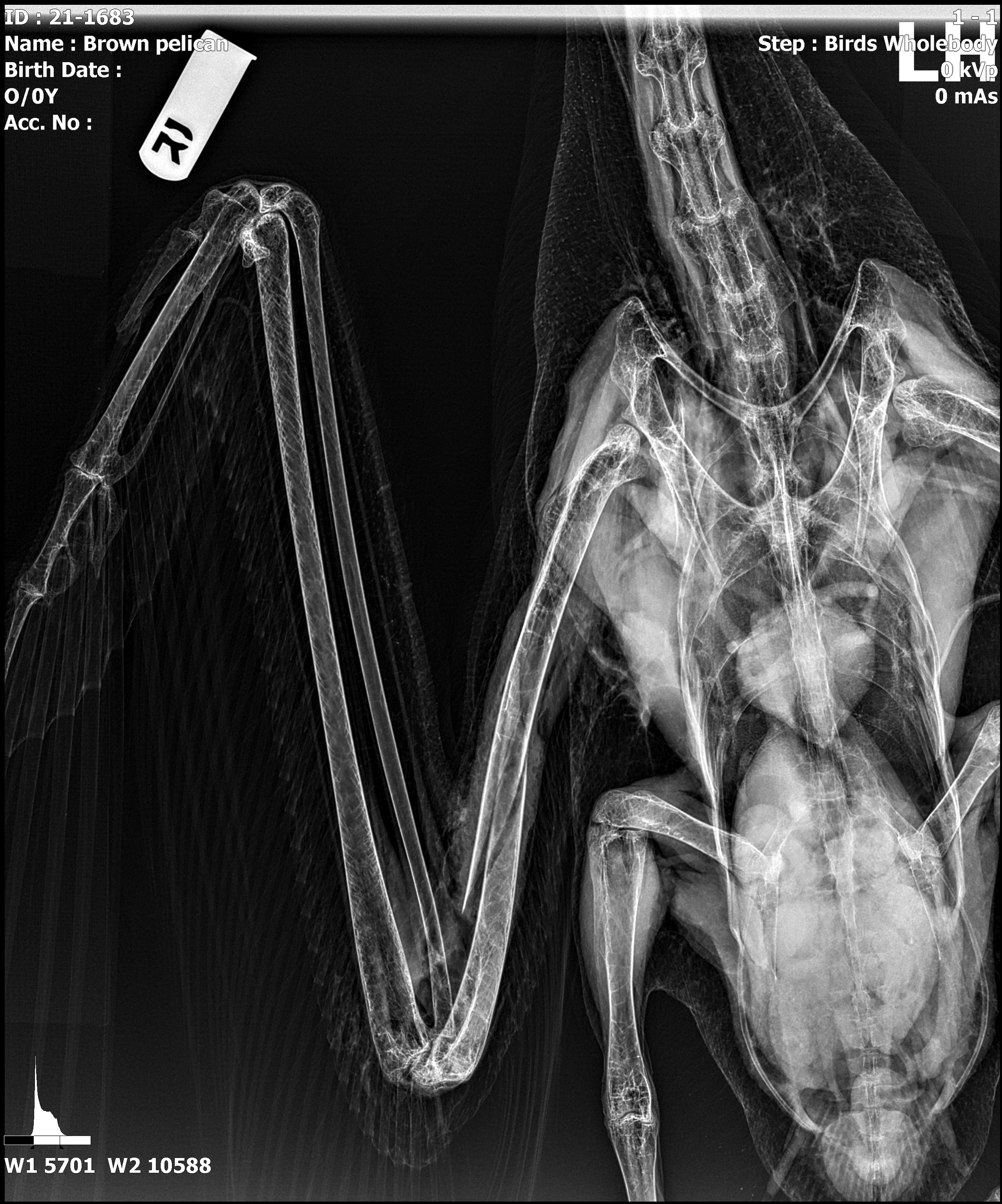
X-Ray of Patient# 1683’s right wing fracture

In September 2021, a Brown Pelican was admitted to Pelican Harbor with a fractured humerus bone in its right wing. Orthopedic surgery was performed where multiple pins were placed in cross sections across the bone to stabilize the fracture and enable the bones to fuse properly. In addition to the pins, an external fixator device was also placed at the site. This involves a piece of acrylic encased in a tube that is placed on the outside of the wing to keep the pins in place and limit rotation so the bone heals properly. This type of surgery is a huge undertaking for wounded animals, as the stress of going under anesthesia for long periods of time can cause adverse reactions. Thankfully, patient  #21-1683 made it through the surgery successfully. What followed was 6 months of hard work on the part of not just the rehab team but the pelican himself. Every day he received physical therapy and medications to aid in his healing. We had to ensure he would have a full range of motion in his wing so that he could fly, hunt for food, and most importantly, live and thrive on his own in the wild.
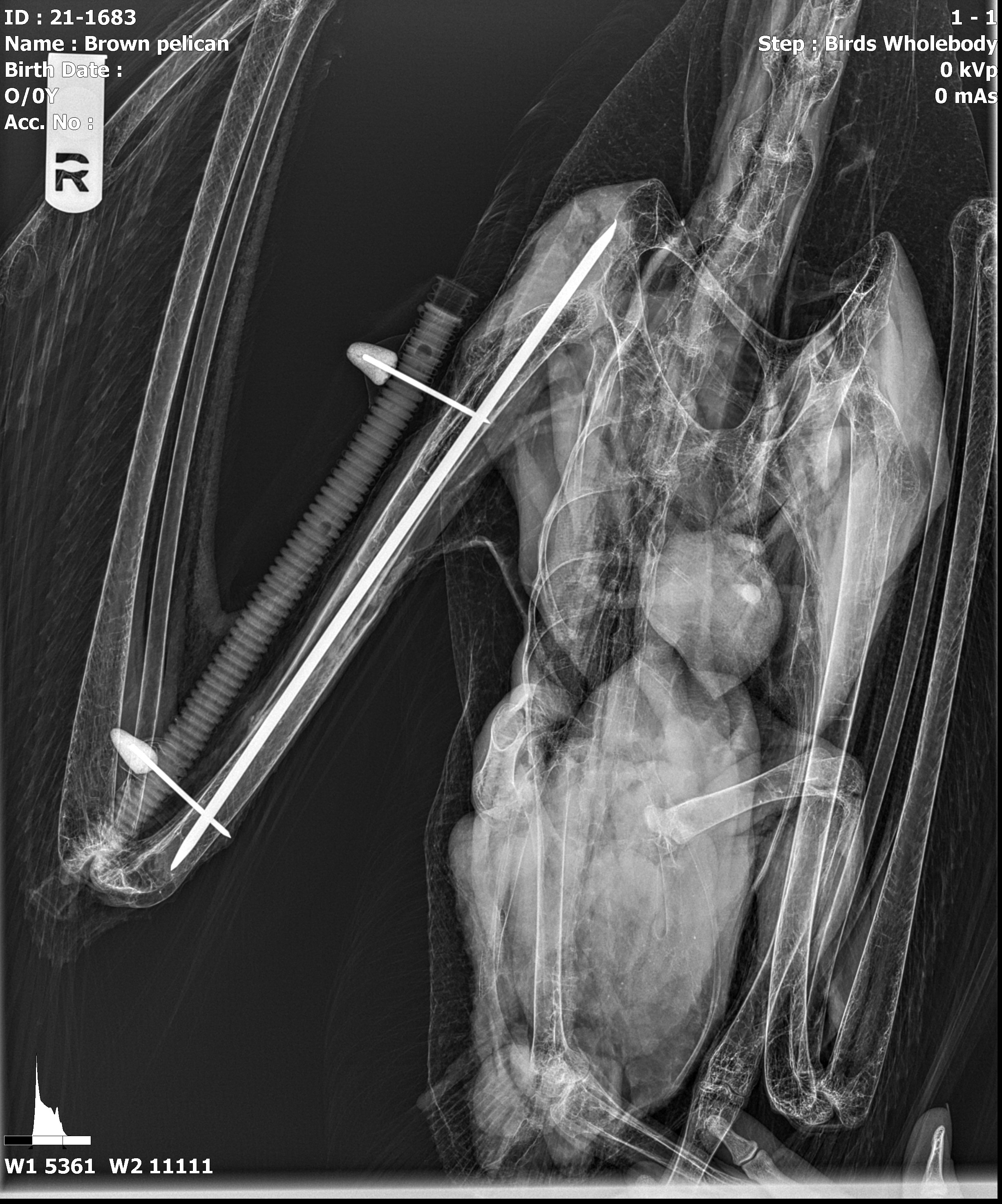
X-Ray of Patient# 1683’s external fixator device

In March 2022, 6 months after its initial intake, release day finally came for our pelican. He had completed his physical therapy and proved to us he could fly and hunt on his own despite a persistent but benign wing droop. This is the happiest day for our rehabilitation team because it’s the culmination of all our worry and hard work. Undoubtedly, it’s the best day for the animal too! He was released with another pelican on our property here in Miami, where they flew off together, and we considered it another successful release. 

However, over the next couple of months, we got numerous calls from people worried that the pelican was unable to fly due to his wing droop. After some time monitoring him and multiple visits to the jetty, it was determined that he was not thriving in the wild due to consistent human intervention and he was brought back to PHSS for further evaluation. We decided to relocate him to an area that would not have the amount of human interaction he had in his previous release area.

Patient# 1683 with injured right wing

 Then, we started getting calls about Facebook videos being posted of people interacting with him in various ways around the Haulover Jetty area–touching him, petting him, feeding him fish, and attempting to “help” him even though he was more than capable of taking care of himself. Despite numerous attempts of release at different locations, the pelican kept returning to the Haulover Jetty, where he had seemingly become irreversibly accustomed to being fed by humans. Because of this, he was deemed unreleasable by our veterinarians and had to be permanently placed at a sanctuary, where he will live out the rest of his life in captivity. 

Please remember when you see a wild animal, they are just that– wild. Always be sure to keep your distance, and never feed wildlife. In order to thrive and survive, they need to keep their wild instincts. When animals become habituated to humans, they no longer want to look for their own food and instead spend their time in heavily populated areas. In the case of pelicans specifically, when they start to see humans as a source of food, they end up getting hooked because they hang out in fishing areas. This results in various injuries and entanglement, sometimes ingesting the hooks themselves which can ultimately result in death. Additionally, people feed them food that isn’t meant for them which can get stuck in their throat or make its way to their stomach where it then destroys their intestinal tract because it is too big for what their bodies are supposed to eat.

The best way to be a friend to wild animals is to stay as far away as possible and let them live their lives without our influence. As always, refrain from feeding, holding, or petting wild animals, no matter how friendly they may seem. 

Got milk?...not so fast!

Written by: Carolina Labro, Wildlife Rehabilitator

Note from our team: If you found a baby squirrel, opossum, or bird, do not attempt to feed it. Feeding from anyone but a professional rehabilitator may result in additional medical problems. It is easier to treat a hungry patient than it is to feed the issues that may be caused by improper feeding.

We all know that milk is a critical component of nutrition for any wild baby mammal's healthy growth, development, and survival. It supplies essential fats, proteins, antibodies, vitamins, and minerals to the neonate during a very important part of its life. But did you know that there are two crucial aspects of milk when raising orphan babies? 

They are Components and Compositions

Milk has six major components: water, fat, protein, carbohydrates, vitamins, and minerals. However, its composition differs widely from species to species. This difference is closely associated with an animal’s environment, diet, and life history, and is why it is so important never to attempt to bottle feed any orphaned wildlife you may find. 

Herbivorous species produce milk lower in fat and protein concentrations due to a diet based on plants and grass. Conversely, omnivorous species produce milk high in fat and protein as a result of animal matter contained in their diet. 

The only component that is equal in composition in all types of mammal milk is colostrum, or “the first milk” secreted by nursing mothers. Colostrum is extremely high in immunoglobulins (antibodies) and provides the newborn with immunity to fight gastrointestinal tract infections as it grows. 

During the course of lactation, the composition of a mammal’s milk will change drastically to meet the nutritional needs of each developmental stage. For example, a baby Grey Squirrel weighing 45 grams requires a formula with a high fat to low protein ratio. When the same Grey Squirrel reaches 75g, it now requires a formula low in protein and high in fat. Similarly, Virginia Opossums weighing less than 45g require a formula with a medium protein to high-fat ratio, but when they exceed 45g, they require a formula with low protein to medium fat levels.

Although there is no perfect substitute for natural milk, there are specially formulated wildlife milk substitutes based on the analysis of the species' natural milk.  When feeding an orphaned wild baby, it is important to know that the wrong formula will cause delayed growth in size, sparse fur, muscle weakness, bone abnormalities, lack of tooth development, and even death. This is due to their immature GI tract being unable to process milk with inappropriate compositions. Products that do not provide adequate nutrition for wildlife include cow’s milk, evaporated milk, human infant formula, plant-based milks, and any homemade recipe. 

Knowledge of the specific nutritional requirements of orphan wild babies is vital to support healthy growth and to increase the chance of releasing an animal that can survive in the wild. If you ever come across a wild baby mammal, be sure to bring it to a licensed wildlife rehabilitator as soon as possible!

Butterflies on a Budget - How to cultivate a native butterfly garden for next to free 

Written by: Samantha Martinez, Environmental Educator

Not only are butterflies one of nature's most diverse, colorful, and elegant species, but they are also great pollinators. While not as effective as bees or wasps at diligently pollinating plants quickly one after another, butterflies take a more leisurely approach to pollination which helps these plants in a different but no less important way. Since butterflies don’t have responsibilities to a hive like bees, they can feel free to take their time drinking the nectar of different plants and wait a while, and travel quite a bit before landing on another one. This may seem inefficient, but pollen has been shown to stay fresh on the tongues and legs of butterflies longer than they would on other surfaces or in the air. Plus, the fact that butterflies travel far before landing on another flower means that the plants they pollinate will have a different DNA profile than the last plant they were on. Meaning that the plants they pollinate will be cross-pollinated and have a more diverse DNA profile, leading to an overall healthier plant population. 

That being said, how can we attract these prepossessing pollinators to our homes without introducing invasive plants or breaking the bank? Today we’ll go over some of the easiest, and cheapest ways to create a beautiful, eco-friendly butterfly garden. 

Make a Garden Bed 

Raised garden beds are often more productive than planting your plants straight in the ground since the soil is not as compacted and has better drainage. This may seem like something difficult and unattainable on certain budgets or with certain time restraints, but this can be a very easy and inexpensive process. Here are some materials that you can use to create your raised bed and where you can find them. 

  1. Cinder Blocks make for great fencing for your garden. If you don’t already have some laying around your property or neighborhood, you can often find them for free on apps like Offer-Up where people are just looking to get them removed from their backyards. You can either stack the blocks to whatever height and width you want for your garden without any adhesive, or if you want to secure your cinderblocks to one another, you can find cheap outdoor cement on Amazon.

  2. Bricks are another material that you can usually find for very cheap on Offer Up or by asking local construction sites if they have any materials similar that are being thrown away. Construction sites will usually be happy to let you take leftover materials as they have to pay for their  removal anyway. This is another material you may want to secure with the outdoor concrete mentioned above. 

  3. Wood from pallets - We have all seen wooden pallets being thrown out on the side of the road. This material need not go to waste, though not the best quality wood this would absolutely work for a raised bed frame.  This technique may take more tools depending on the style of raised bed you would like. Many youtube videos and articles can be found on how to assemble this easily online, like this one here

Cinder Block Raised bed. Thank you to Bonnie's Plants for this photo 

Raised bed made from pallet wood. Thank you to 99pallets.com for this photo

Line Your Garden Bed

A lining for your garden bed is important to prevent plants you are not trying to grow from taking advantage of the bed you have created.

  1. Newspapers can be a cheap or free option for your lining. Though it will eventually decompose you can prolong its use by layering quite a few papers at the bottom of your raised bed. Plus once it does decompose it will add carbon to your soil which will be beneficial for your plants. Though some may be worried about the inc getting into your soil, newspaper inc is made of soy and therefore will not negatively affect your soil or your plants. 

  2. Cardboard is also a readily available material that can be used to line your garden bed. Though it will also decompose within 6 months you can prolong this by putting multiple layers of cardboard just like with the newspaper option. You can pretty much use any type of cardboard except for any with a waxy coating like those used for cereal boxes. This kind will leak toxins into the soil and eventually into your plants. 

  3. Leaves are another great option, any leaves you can find to provide a thick layered covering. It may even take longer for these to biodegrade than cardboard, holding out for about 6 months to a year. Once they do decompose you will have added quite a bit of organic nutrients to your soil. 

  4. Nothing - You can always decide to not use any covering for the base of your raised bed. You may have to watch out more vigilantly for stray plants but it is completely doable to keep up your raised garden without a base barrier. 

Soil 

Soil may be the one ingredient for your garden that you have to buy, since digging up a giant hole from your backyard may be inconvenient later on. Plus a lot of the soil in south florida unfortunately doesn’t harbor the nutrients needed to grow a healthy garden. Luckily, bags of soil can be found at essentially any hardware store or gardening center for, dare I say, dirt cheap.  

The Plants! 

Now off to the very exciting part, planting the plants in your garden! Below is a list of native plants, or plants with low invasion risk that can either be propagated from plants around South Florida or whose seeds can be collected from a few organizations down here and will be sure to attract some beautiful butterflies and other pollinators to your garden! 

  1. Firespike - Firespike is a lovely, Florida native, addition to your garden that will help attract several species of butterflies and perhaps even hummingbirds! 

  2. Firebush - This native plant will attract some butterflies and hummingbirds for its nectar. It will also produce some small berries that will be enjoyed by birds and small mammals in your neighborhood! 

  3. Blue Porterweed - Yet another Florida native, this plant is a host plant for tropical buckeye butterflies but will attract other species of butterfly, as well as bees to your garden! 

  4. Orange Milkweed ( Asclepias Tuberosa) - Milkweed is a well-known butterfly attractor and host plant. This species of milkweed is also a Florida native and will help attract butterflies, bees and other insects to your home! 

  5. Passion Flower - This beautiful plant is known to attract honey bees, carpenter bees and  Gulf Fritillary butterflies! Like many of the other plants on this list it is also a beautiful flowering plant to be admired all on its own.

  6. Bahama Cassia - This plant is known for attracting butterflies of the Sulfur species. It is used as a food source for both adult butterflies and larvae. 


There are many other Florida native, or low invasion risk plants you can use to enrich your butterfly garden. Many can be found in small nurseries for a very low cost or you can reach out to organizations such as The Miami Seeds Share and others for seed donations they have available. I hope this article has helped you find it more realistic to create a beautiful butterfly garden with plants that will help augment the habitat that is your yard for you and the creatures you share it with! Happy gardening everyone! 

A Home for the Fish and the Feathered

Written by: Samantha Martinez, Environmental Educator

Biscayne Bay is known for its beauty, calming atmosphere, and views of the islands and city weather that view is from a kayak or a yacht. People from all over the Miami area enjoy the recreational activities that the bay makes possible. Here at Pelican Harbor Seabird Station, we receive hundreds of wading and seabirds annually, more so than any other group of avians. This is in no small part due to the kind-hearted people who choose to bring in injured or ill wildlife they discover on their outings. Without the eyes and ears of these good samaritans, many of these animals would not make their way into care. 

An adult and a juvenile Magnificent Frigate Bird roosting on an Island in Biscayne Bay

Nevertheless, we cannot ignore the impact of  our proximity to Biscayne Bay. There are many ways in which our society unintentionally brings harm to our local environment, but luckily there are even more ways that we can make small changes in our lives to help repair it. For example, adopting safe fishing and boating practices, like casting with care and disposing of hook and line properly, helps to prevent wildlife injury and entanglement. If you ever do find a bird on the other side of your fishing line, you can always reel them in and contact Pelican Harbor Seabird Station to get them into care. You can also reduce chemical runoff by planting native plants in your yard and using natural herbicides. Additionally, you can reduce your plastic consumption, avoid littering, use reef-safe sunscreens and so much more! These small, seemingly insignificant actions, together, make such a big impact on our environment and with a little knowledge and a bit of motivation, Biscayne Bay can once again be the thriving, rich environment it is meant to be.

Each organism within the bay, from newly hatched crustaceans to the bottlenose dolphin, plays a role in which there is no understudy. So before we enjoy our weekend on the water, let us all take a moment to appreciate the tremendous importance of this ecosystem and what we can do to help preserve it and the animals, including us, who rely on it.