Environmental

Butterflies on a Budget - How to cultivate a native butterfly garden for next to free 

Written by: Samantha Martinez, Environmental Educator

Not only are butterflies one of nature's most diverse, colorful, and elegant species, but they are also great pollinators. While not as effective as bees or wasps at diligently pollinating plants quickly one after another, butterflies take a more leisurely approach to pollination which helps these plants in a different but no less important way. Since butterflies don’t have responsibilities to a hive like bees, they can feel free to take their time drinking the nectar of different plants and wait a while, and travel quite a bit before landing on another one. This may seem inefficient, but pollen has been shown to stay fresh on the tongues and legs of butterflies longer than they would on other surfaces or in the air. Plus, the fact that butterflies travel far before landing on another flower means that the plants they pollinate will have a different DNA profile than the last plant they were on. Meaning that the plants they pollinate will be cross-pollinated and have a more diverse DNA profile, leading to an overall healthier plant population. 

That being said, how can we attract these prepossessing pollinators to our homes without introducing invasive plants or breaking the bank? Today we’ll go over some of the easiest, and cheapest ways to create a beautiful, eco-friendly butterfly garden. 

Make a Garden Bed 

Raised garden beds are often more productive than planting your plants straight in the ground since the soil is not as compacted and has better drainage. This may seem like something difficult and unattainable on certain budgets or with certain time restraints, but this can be a very easy and inexpensive process. Here are some materials that you can use to create your raised bed and where you can find them. 

  1. Cinder Blocks make for great fencing for your garden. If you don’t already have some laying around your property or neighborhood, you can often find them for free on apps like Offer-Up where people are just looking to get them removed from their backyards. You can either stack the blocks to whatever height and width you want for your garden without any adhesive, or if you want to secure your cinderblocks to one another, you can find cheap outdoor cement on Amazon.

  2. Bricks are another material that you can usually find for very cheap on Offer Up or by asking local construction sites if they have any materials similar that are being thrown away. Construction sites will usually be happy to let you take leftover materials as they have to pay for their  removal anyway. This is another material you may want to secure with the outdoor concrete mentioned above. 

  3. Wood from pallets - We have all seen wooden pallets being thrown out on the side of the road. This material need not go to waste, though not the best quality wood this would absolutely work for a raised bed frame.  This technique may take more tools depending on the style of raised bed you would like. Many youtube videos and articles can be found on how to assemble this easily online, like this one here

Cinder Block Raised bed. Thank you to Bonnie's Plants for this photo 

Raised bed made from pallet wood. Thank you to 99pallets.com for this photo

Line Your Garden Bed

A lining for your garden bed is important to prevent plants you are not trying to grow from taking advantage of the bed you have created.

  1. Newspapers can be a cheap or free option for your lining. Though it will eventually decompose you can prolong its use by layering quite a few papers at the bottom of your raised bed. Plus once it does decompose it will add carbon to your soil which will be beneficial for your plants. Though some may be worried about the inc getting into your soil, newspaper inc is made of soy and therefore will not negatively affect your soil or your plants. 

  2. Cardboard is also a readily available material that can be used to line your garden bed. Though it will also decompose within 6 months you can prolong this by putting multiple layers of cardboard just like with the newspaper option. You can pretty much use any type of cardboard except for any with a waxy coating like those used for cereal boxes. This kind will leak toxins into the soil and eventually into your plants. 

  3. Leaves are another great option, any leaves you can find to provide a thick layered covering. It may even take longer for these to biodegrade than cardboard, holding out for about 6 months to a year. Once they do decompose you will have added quite a bit of organic nutrients to your soil. 

  4. Nothing - You can always decide to not use any covering for the base of your raised bed. You may have to watch out more vigilantly for stray plants but it is completely doable to keep up your raised garden without a base barrier. 

Soil 

Soil may be the one ingredient for your garden that you have to buy, since digging up a giant hole from your backyard may be inconvenient later on. Plus a lot of the soil in south florida unfortunately doesn’t harbor the nutrients needed to grow a healthy garden. Luckily, bags of soil can be found at essentially any hardware store or gardening center for, dare I say, dirt cheap.  

The Plants! 

Now off to the very exciting part, planting the plants in your garden! Below is a list of native plants, or plants with low invasion risk that can either be propagated from plants around South Florida or whose seeds can be collected from a few organizations down here and will be sure to attract some beautiful butterflies and other pollinators to your garden! 

  1. Firespike - Firespike is a lovely, Florida native, addition to your garden that will help attract several species of butterflies and perhaps even hummingbirds! 

  2. Firebush - This native plant will attract some butterflies and hummingbirds for its nectar. It will also produce some small berries that will be enjoyed by birds and small mammals in your neighborhood! 

  3. Blue Porterweed - Yet another Florida native, this plant is a host plant for tropical buckeye butterflies but will attract other species of butterfly, as well as bees to your garden! 

  4. Orange Milkweed ( Asclepias Tuberosa) - Milkweed is a well-known butterfly attractor and host plant. This species of milkweed is also a Florida native and will help attract butterflies, bees and other insects to your home! 

  5. Passion Flower - This beautiful plant is known to attract honey bees, carpenter bees and  Gulf Fritillary butterflies! Like many of the other plants on this list it is also a beautiful flowering plant to be admired all on its own.

  6. Bahama Cassia - This plant is known for attracting butterflies of the Sulfur species. It is used as a food source for both adult butterflies and larvae. 


There are many other Florida native, or low invasion risk plants you can use to enrich your butterfly garden. Many can be found in small nurseries for a very low cost or you can reach out to organizations such as The Miami Seeds Share and others for seed donations they have available. I hope this article has helped you find it more realistic to create a beautiful butterfly garden with plants that will help augment the habitat that is your yard for you and the creatures you share it with! Happy gardening everyone! 

A Home for the Fish and the Feathered

Written by: Samantha Martinez, Environmental Educator

Biscayne Bay is known for its beauty, calming atmosphere, and views of the islands and city weather that view is from a kayak or a yacht. People from all over the Miami area enjoy the recreational activities that the bay makes possible. Here at Pelican Harbor Seabird Station, we receive hundreds of wading and seabirds annually, more so than any other group of avians. This is in no small part due to the kind-hearted people who choose to bring in injured or ill wildlife they discover on their outings. Without the eyes and ears of these good samaritans, many of these animals would not make their way into care. 

An adult and a juvenile Magnificent Frigate Bird roosting on an Island in Biscayne Bay

Nevertheless, we cannot ignore the impact of  our proximity to Biscayne Bay. There are many ways in which our society unintentionally brings harm to our local environment, but luckily there are even more ways that we can make small changes in our lives to help repair it. For example, adopting safe fishing and boating practices, like casting with care and disposing of hook and line properly, helps to prevent wildlife injury and entanglement. If you ever do find a bird on the other side of your fishing line, you can always reel them in and contact Pelican Harbor Seabird Station to get them into care. You can also reduce chemical runoff by planting native plants in your yard and using natural herbicides. Additionally, you can reduce your plastic consumption, avoid littering, use reef-safe sunscreens and so much more! These small, seemingly insignificant actions, together, make such a big impact on our environment and with a little knowledge and a bit of motivation, Biscayne Bay can once again be the thriving, rich environment it is meant to be.

Each organism within the bay, from newly hatched crustaceans to the bottlenose dolphin, plays a role in which there is no understudy. So before we enjoy our weekend on the water, let us all take a moment to appreciate the tremendous importance of this ecosystem and what we can do to help preserve it and the animals, including us, who rely on it. 

Preserving our Urban Paradise

Written by: Samantha Martinez, Environmental Educator

Barn Owl 22-842

In Miami, we are constantly growing and upgrading our infrastructure as new homes, highways, and businesses are built daily to expand our urban paradise. This, on occasion, can come at the cost of the homes of our wild neighbors. This is what may have happened to patient 21-842, a juvenile Barn Owl. This owl was found on a construction site after a tree, believed to be harboring the bird's nest, was cut down. Unable to fly and with dry blood covering his feet and nares, the owl was brought into Pelican Harbor Seabird Station.  We see this all too often at PHSS, especially during the spring months as people prepare for hurricane season.

Once in care, our rehabbers noticed swelling and lameness in this patient's right leg, with x-rays confirming a midshaft fracture to the tarsometatarsus bone. The rehab team thoroughly cleaned the area and added a half splint with firm cast material to immobilize the young owl's leg during the healing process. This, coupled with supportive care, antibiotics, and pain medication, has this bird on the road to recovery. However, there is still a long way to go, and not all displaced fledglings are so lucky.

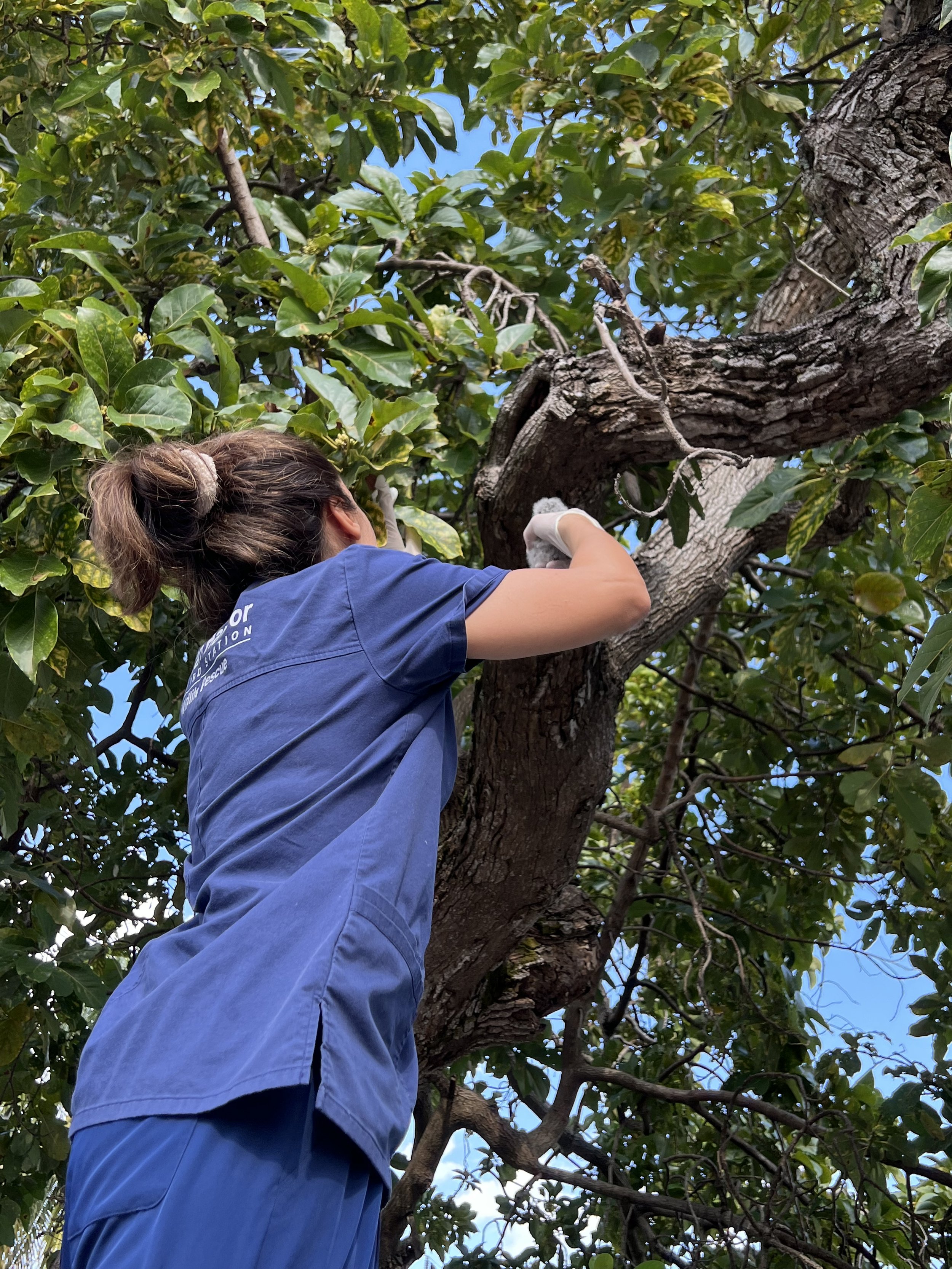
Wildlife rehabber, Carolina, renesting a displaced Eastern Screech Owl nestling.

We understand that tree trimming and construction are often unavoidable facts of urban life, especially considering the need to prevent damage from hurricanes. However, we recommend some simple ways to help avoid harm to wildlife when starting a building project or trimming trees for whatever reason. Such methods include doing an initial survey of the area to see if any wildlife is inhabiting it. You can check for droppings, nests, or nesting materials, and listen for animals in the immediate vicinity. If you find that an animal is nesting in a tree you plan to trim, we recommend leaving all branches supporting the nest as well as those protecting it from weather and predators until all babies have left the nest. Most birds will be done nesting by mid-July. Following these simple steps will help save countless nesting birds and mammals and prevent you from receiving costly fines associated with disturbing a federally protected nest. To learn more about protecting wildlife while trimming trees, feel free to reach out to us for a copy of our Animal Safety for Arborist sheet. 

Saved by the Power of Light

Written by: Milena Orjuela, PHSS Intern

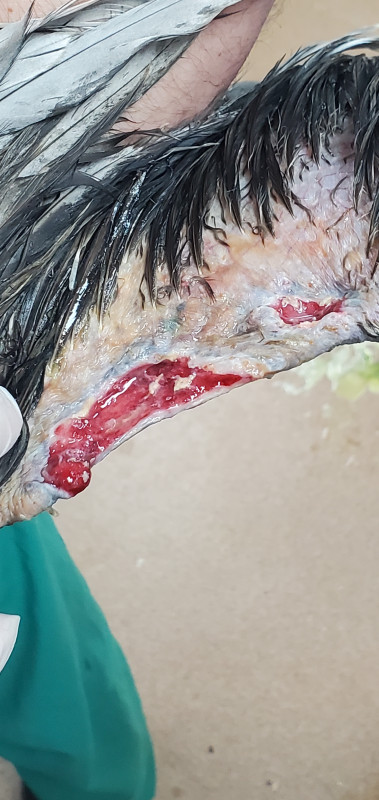
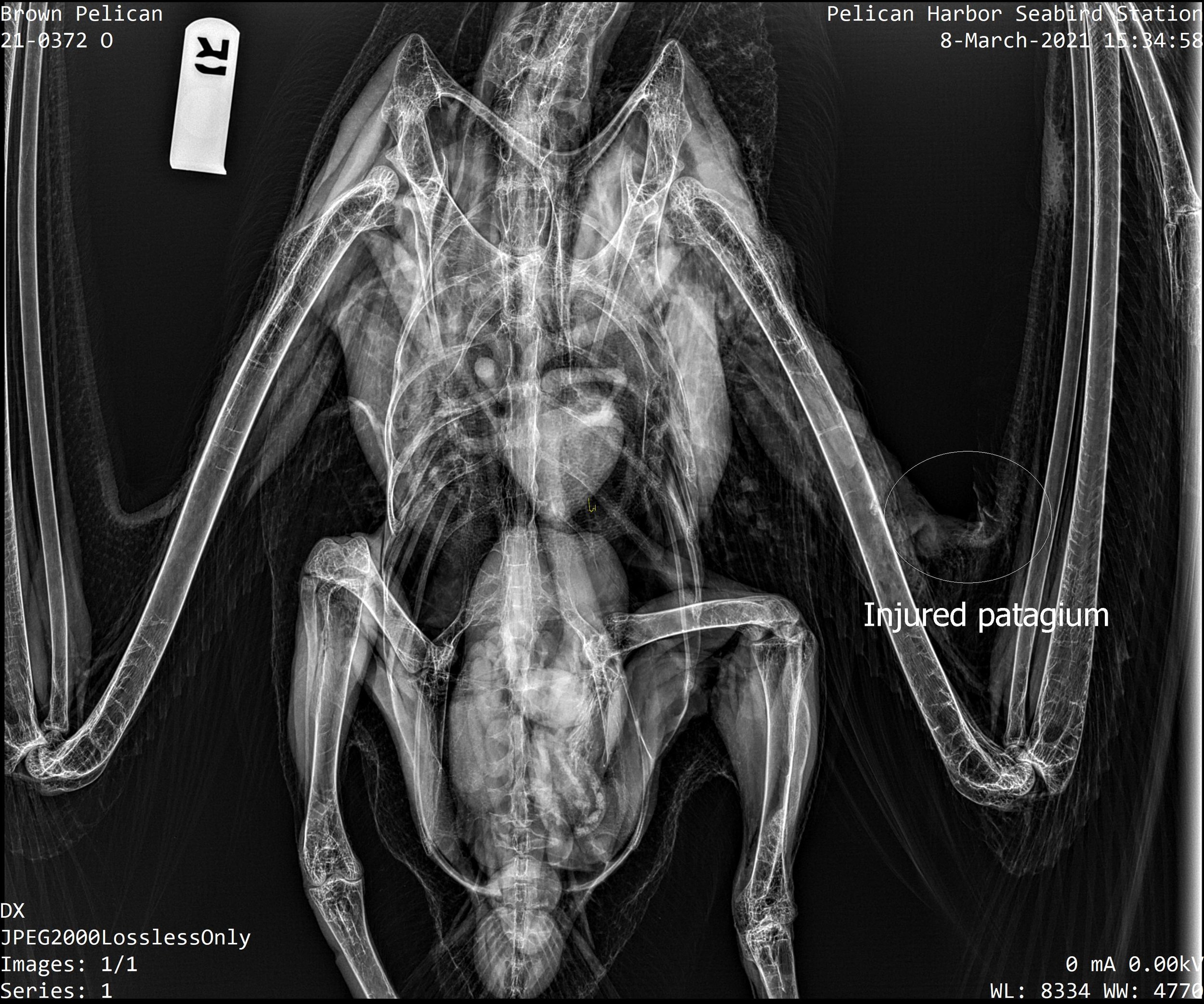
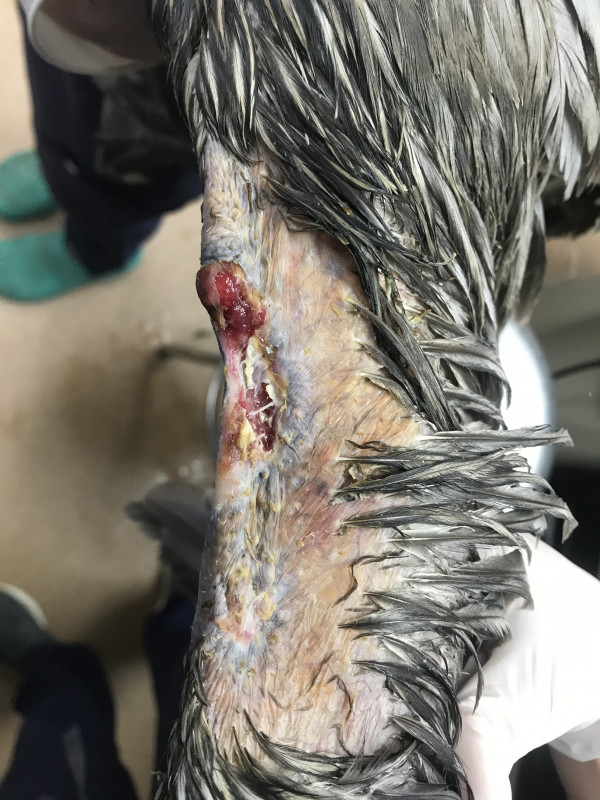
Pelicans are meant to glide through the sky, dipping in and out of the ocean on a sunny day, and leaving your jaw dropped if they happen to catch a fish near you. That is what I thought until Pelican 21-372 came to our clinic. After taking a quick glance at the bird, I secretly thought to myself, “you are doomed.” Pelican 21-372 first came into our care after being spotted with monofilament entangling its left wing, upper body, and head. It was obvious upon examination that the bird was also malnourished and dehydrated. Our staff noted multiple open wounds in its face, abdomen, legs, and a large malodorous wound on the left patagium. A malodorous wound is characterized by necrotic tissue, or bacterial colonization, often containing both anaerobes and aerobes and is a major obstruction to healing. The patagium, the site of the open wound, is a web of elastic fibers that extends from the head to the wrist and has the very important job of assisting birds in gliding and flying. Such a grave injury on a crucial part of the bird’s wing is why Pelican 21-372’s chances were initially seen as quite poor. 

A set of X-rays determined that there were no fractures or broken bones to deal with in addition to the obvious open wounds. Subcutaneous fluids were given to aid with dehydration, antibiotics, pain killers, anti-inflammatories, and Vitamin E were administered to help the healing process, and the pelican was given one dose of anti-parasitic medication. All wounds were thoroughly cleansed and special care was given to the left wing. All dead tissue was removed from the patagium, a topical antibiotic ointment was administered, and the wing was wrapped. Though the physical treatments and medications certainly had a very beneficial role in healing the bird, the laser therapy Pelican 21-372 received is what really allowed such a miraculous recovery. 

First developed in 1960, laser therapy can heal major injuries at a cellular level by stimulating a process called photobiomodulation. Photobiomodulation or PBM works as photons enter the tissue and interact with the Cytochrome C complex inside cellular mitochondria. The absorption of light by the Cytochrome C oxidase helps the cells to increase the production of Adenosine Triphosphate (ATP), which is the intracellular energy transfer molecule. This helps to restore the oxidative process which allows the cells to resume normal functions, preventing cell death and associated complications. Additionally, laser therapy can stimulate the production of free nitric oxide (NO) and reactive oxygen species (ROS), which is a powerful vasodilator, and an important signaling molecule, respectively. Together, these chemical compounds and molecules can promote faster signaling, decreased edema, reduced inflammation, and a faster healing process. Looking at the body as a whole, PBM causes a beneficial systemic effect by expanding cellular proliferation, improving microcirculation in the tissue, and inducing growth factor production. Because the results of photobiomodulation are very dose-dependent, the strength of the therapy is selected according to the patient’s clinical presentation. High frequency (above 500hz) penetrates shallow tissue which will inhibit pain, swelling, and nerve damage. In contrast, lower frequency (under 500Hz) targets deeper tissue which speeds the healing process and is specifically used when reproduction of new cells is required.

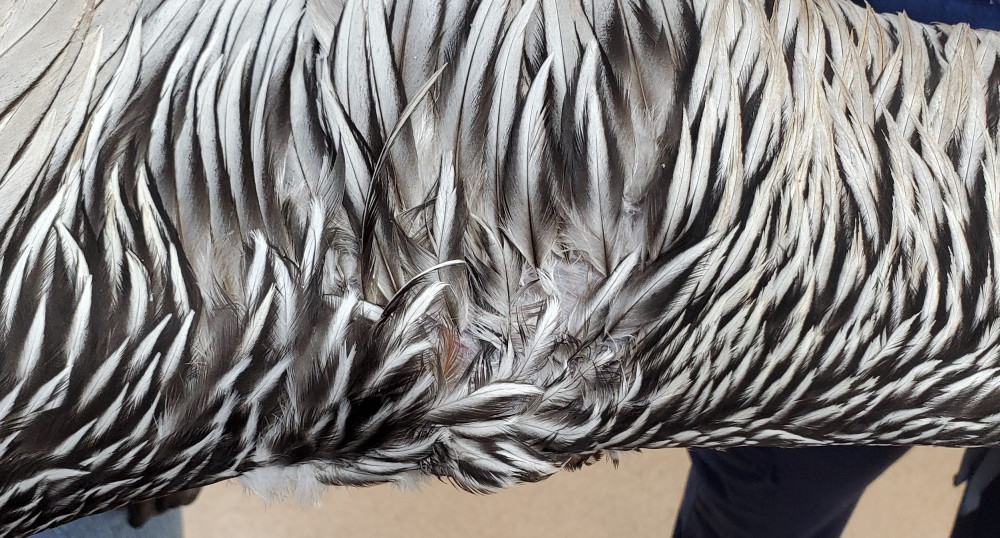
In this case, our beloved Pelican 21-372 received low-frequency laser therapy, during which 50Hz were administered throughout the treatment. As hoped, the laser therapy significantly improved wound proliferation with comfort and ease. Treatment times should be reduced as healing begins and the injury begins to show improvement. For example, if a 3” incision takes 3 minutes to treat, then a 2” one would take 2 minutes. Any additional photons delivered over the required dose will then become inhibitory, creating a plateau in the healing process. Physical treatments, medication, and the impressive work of the laser therapy made the wound healing so significant that pelican 21-372 was described as a “healing machine” by one of our staff members. Within 16 days of admission, the pelican was spending time outside in the sunny weather, and even flying around the enclosure. It was then that the final round of antibiotics and pain killers were administered, to allow for a few more days of active healing. Although the wound was healed, the Brown pelican needed more time to regain full extension of the wing. Without full extension of the patagium, the bird would not be able to fly. To help the Pelican on the path to regain full extension and fly our staff would do physical therapy on the patient as well as allow the patient to do its own physical therapy by being outside. After nearly four months of this arduous job, all of our efforts yielded great results and Pelican 21-372 was able to be released. Next time you are at the beach and see a pelican flying by, remember that wildlife is precious and take pride in knowing they will be protected and cared for!