Wildlife Hospital

Keep Our Wildlife Wild!

Written by: Amanda Burke, Wildlife Rehabilitator & Intern Coordinator
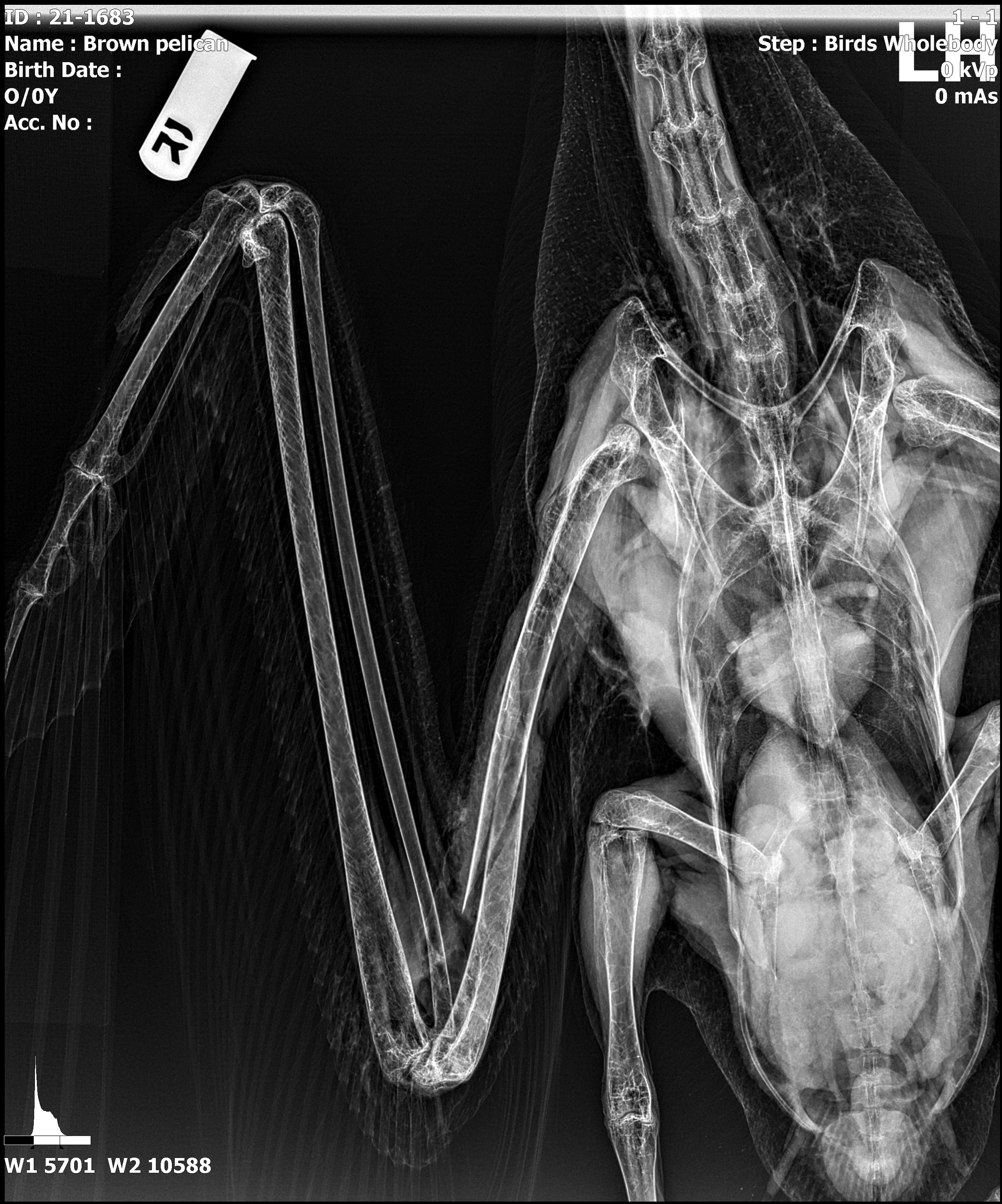
X-Ray of Patient# 1683’s right wing fracture

In September 2021, a Brown Pelican was admitted to Pelican Harbor with a fractured humerus bone in its right wing. Orthopedic surgery was performed where multiple pins were placed in cross sections across the bone to stabilize the fracture and enable the bones to fuse properly. In addition to the pins, an external fixator device was also placed at the site. This involves a piece of acrylic encased in a tube that is placed on the outside of the wing to keep the pins in place and limit rotation so the bone heals properly. This type of surgery is a huge undertaking for wounded animals, as the stress of going under anesthesia for long periods of time can cause adverse reactions. Thankfully, patient  #21-1683 made it through the surgery successfully. What followed was 6 months of hard work on the part of not just the rehab team but the pelican himself. Every day he received physical therapy and medications to aid in his healing. We had to ensure he would have a full range of motion in his wing so that he could fly, hunt for food, and most importantly, live and thrive on his own in the wild.
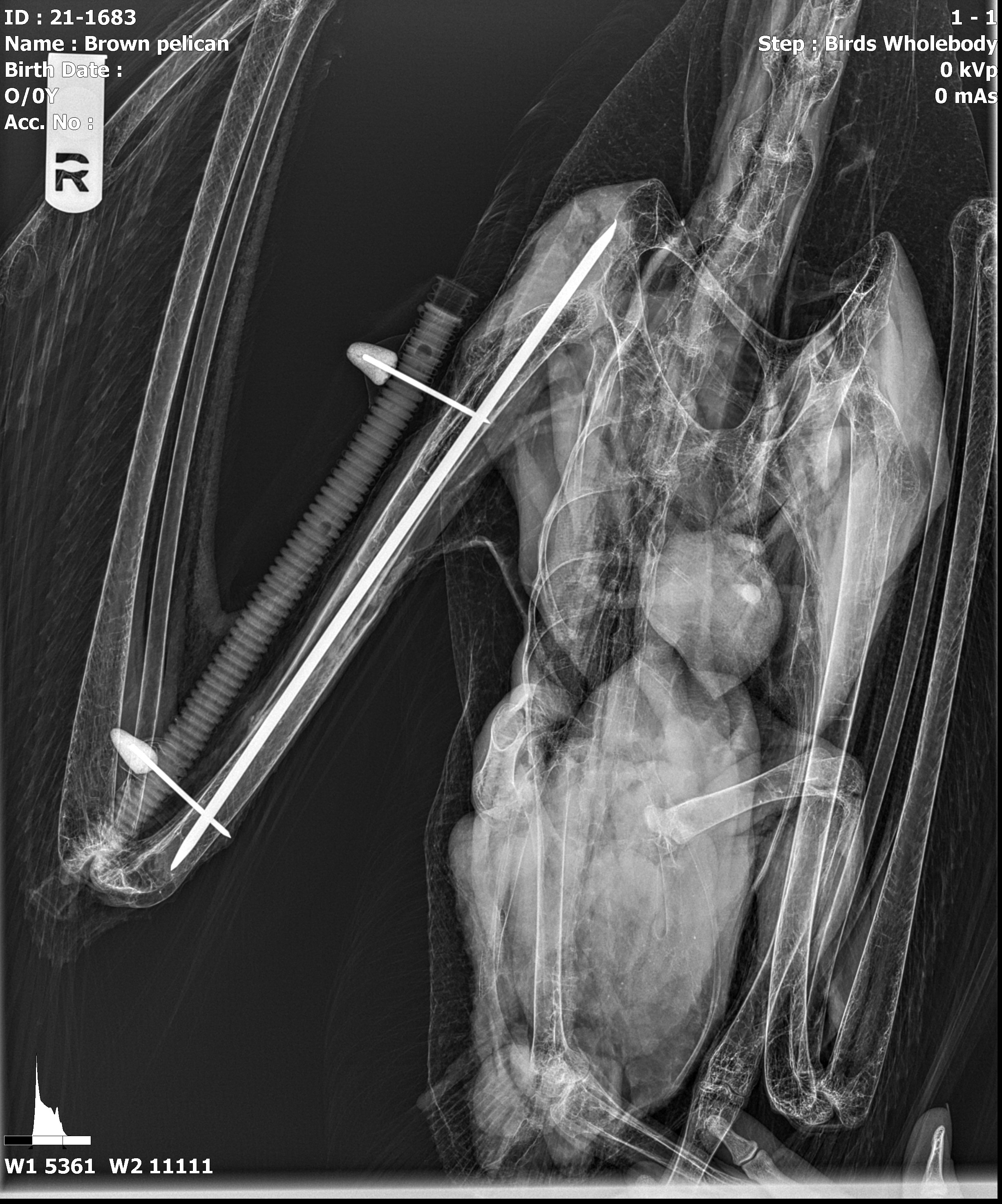
X-Ray of Patient# 1683’s external fixator device

In March 2022, 6 months after its initial intake, release day finally came for our pelican. He had completed his physical therapy and proved to us he could fly and hunt on his own despite a persistent but benign wing droop. This is the happiest day for our rehabilitation team because it’s the culmination of all our worry and hard work. Undoubtedly, it’s the best day for the animal too! He was released with another pelican on our property here in Miami, where they flew off together, and we considered it another successful release. 

However, over the next couple of months, we got numerous calls from people worried that the pelican was unable to fly due to his wing droop. After some time monitoring him and multiple visits to the jetty, it was determined that he was not thriving in the wild due to consistent human intervention and he was brought back to PHSS for further evaluation. We decided to relocate him to an area that would not have the amount of human interaction he had in his previous release area.

Patient# 1683 with injured right wing

 Then, we started getting calls about Facebook videos being posted of people interacting with him in various ways around the Haulover Jetty area–touching him, petting him, feeding him fish, and attempting to “help” him even though he was more than capable of taking care of himself. Despite numerous attempts of release at different locations, the pelican kept returning to the Haulover Jetty, where he had seemingly become irreversibly accustomed to being fed by humans. Because of this, he was deemed unreleasable by our veterinarians and had to be permanently placed at a sanctuary, where he will live out the rest of his life in captivity. 

Please remember when you see a wild animal, they are just that– wild. Always be sure to keep your distance, and never feed wildlife. In order to thrive and survive, they need to keep their wild instincts. When animals become habituated to humans, they no longer want to look for their own food and instead spend their time in heavily populated areas. In the case of pelicans specifically, when they start to see humans as a source of food, they end up getting hooked because they hang out in fishing areas. This results in various injuries and entanglement, sometimes ingesting the hooks themselves which can ultimately result in death. Additionally, people feed them food that isn’t meant for them which can get stuck in their throat or make its way to their stomach where it then destroys their intestinal tract because it is too big for what their bodies are supposed to eat.

The best way to be a friend to wild animals is to stay as far away as possible and let them live their lives without our influence. As always, refrain from feeding, holding, or petting wild animals, no matter how friendly they may seem. 

Got milk?...not so fast!

Written by: Carolina Labro, Wildlife Rehabilitator

Note from our team: If you found a baby squirrel, opossum, or bird, do not attempt to feed it. Feeding from anyone but a professional rehabilitator may result in additional medical problems. It is easier to treat a hungry patient than it is to feed the issues that may be caused by improper feeding.

We all know that milk is a critical component of nutrition for any wild baby mammal's healthy growth, development, and survival. It supplies essential fats, proteins, antibodies, vitamins, and minerals to the neonate during a very important part of its life. But did you know that there are two crucial aspects of milk when raising orphan babies? 

They are Components and Compositions

Milk has six major components: water, fat, protein, carbohydrates, vitamins, and minerals. However, its composition differs widely from species to species. This difference is closely associated with an animal’s environment, diet, and life history, and is why it is so important never to attempt to bottle feed any orphaned wildlife you may find. 

Herbivorous species produce milk lower in fat and protein concentrations due to a diet based on plants and grass. Conversely, omnivorous species produce milk high in fat and protein as a result of animal matter contained in their diet. 

The only component that is equal in composition in all types of mammal milk is colostrum, or “the first milk” secreted by nursing mothers. Colostrum is extremely high in immunoglobulins (antibodies) and provides the newborn with immunity to fight gastrointestinal tract infections as it grows. 

During the course of lactation, the composition of a mammal’s milk will change drastically to meet the nutritional needs of each developmental stage. For example, a baby Grey Squirrel weighing 45 grams requires a formula with a high fat to low protein ratio. When the same Grey Squirrel reaches 75g, it now requires a formula low in protein and high in fat. Similarly, Virginia Opossums weighing less than 45g require a formula with a medium protein to high-fat ratio, but when they exceed 45g, they require a formula with low protein to medium fat levels.

Although there is no perfect substitute for natural milk, there are specially formulated wildlife milk substitutes based on the analysis of the species' natural milk.  When feeding an orphaned wild baby, it is important to know that the wrong formula will cause delayed growth in size, sparse fur, muscle weakness, bone abnormalities, lack of tooth development, and even death. This is due to their immature GI tract being unable to process milk with inappropriate compositions. Products that do not provide adequate nutrition for wildlife include cow’s milk, evaporated milk, human infant formula, plant-based milks, and any homemade recipe. 

Knowledge of the specific nutritional requirements of orphan wild babies is vital to support healthy growth and to increase the chance of releasing an animal that can survive in the wild. If you ever come across a wild baby mammal, be sure to bring it to a licensed wildlife rehabilitator as soon as possible!

Our Valuable Vultures

Written by: Lucy Wiedmar, PHSS Intern

We’ve all seen it - the ominous collection of large birds gliding high in the sky, seemingly flying in circles around a concentrated area. Often thought to signal that death is near, you ask yourself what the unlucky soul had to endure. The soaring birds in the distance, flying in their ritualistic circles, cruising the wind currents, are most likely members of the new world vulture family.

Florida is home to two native species of vultures, the Black Vulture (Coragyps atratus) and the Turkey Vulture (Cathartes Aura). Both vulture species are in the taxonomic order Accipitriformes (which includes most diurnal birds of prey), and the family Carthartidae (consisting of five new world vulture species.) These two species can be differentiated by the distinct difference in head coloration, with black vultures having a solid black coloration on the head and bill, whilst the turkey vulture differs in a red/pink coloration of the head and a white-toned bill. While in the air, these two vultures can be identified by the difference in flight patterns observed among the two. The black vulture has a much more compact body with a shorter tail, a whitish patch on the outer primaries, and displays a powerful and sturdy 3-5 wing flap pattern. The turkey vulture on the other hand has a greater white-silver coloration along the lower border of their wingspan and tends to teeter while in flight, displaying significantly fewer wing flaps. 


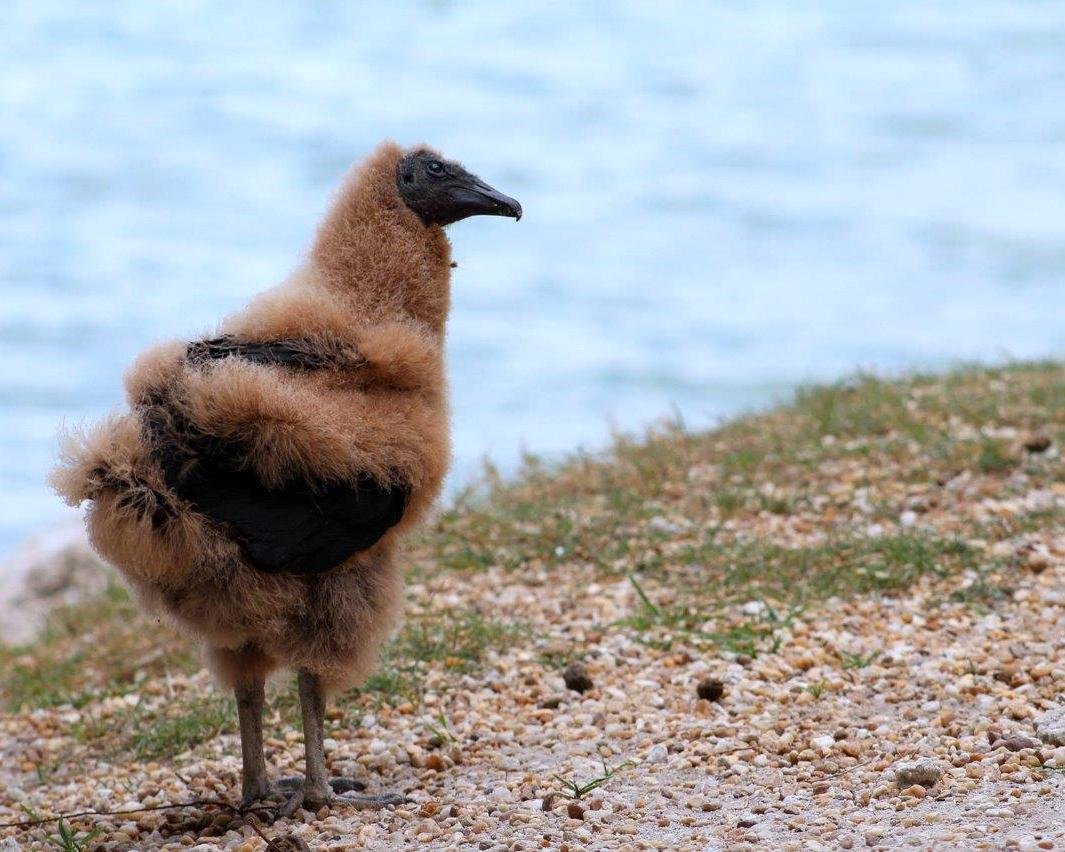
Adult Black Vulture feeding her fledgling.

Adult Turkey Vulture rescued by PHSS volunteers.


Although turkey vultures currently outnumber their black vulture relatives in the United States, black vultures have a greatly expansive native range, outnumbering turkey vultures in the western hemisphere. Year round, black vultures can be located across virtually all of the South American continent up to the southern and eastern United States. Over the past few decades, black vultures have crept their way even further northward - as far north as New England. Turkey vultures have a similar native range, found essentially across all of the South American continent, as well as encompassing almost the entirety of the United States.

While these two species of vultures differ in many aspects, they are very similar in one main regard: their choice of prey - which happens to be most prominently the carcasses of the once living. Due to vultures' feeding behavior relying mainly on carrion, they tend to be associated with negative connotations in the media and are often portrayed in a more “sinister” light, often being depicted as unhygienic or a precursor to death. Even Charles Darwin, the father of evolution, once called the birds “disgusting creatures”. Vultures get a bad rep in the Animal Kingdom, and due to the unwarranted stereotypes placed upon them, there are a lot of misconceptions floating around these birds.

However, I am here to defend the honor of our native vultures! Contrary to the stigmatization of vultures bringing along the notion of death with their presence, they actually play a crucial role in the health and stabilization of their ecosystems. Vultures play an incredibly important role by devouring decaying carcasses. By consuming flesh from the recently deceased, vultures are able to reduce and/or eliminate the spread of certain diseases, pathogens, and harmful bacteria that depend on rotting flesh to grow, develop, and spread. Some of the illnesses prevented by vultures' ecological role are anthrax, rabies, and cholera. Additionally, vultures' diet on carrion further facilitates nutrient cycling by maintaining high fertility among soils for plants to flourish, keeping the overall primary producers of our ecosystems healthy and thriving. 

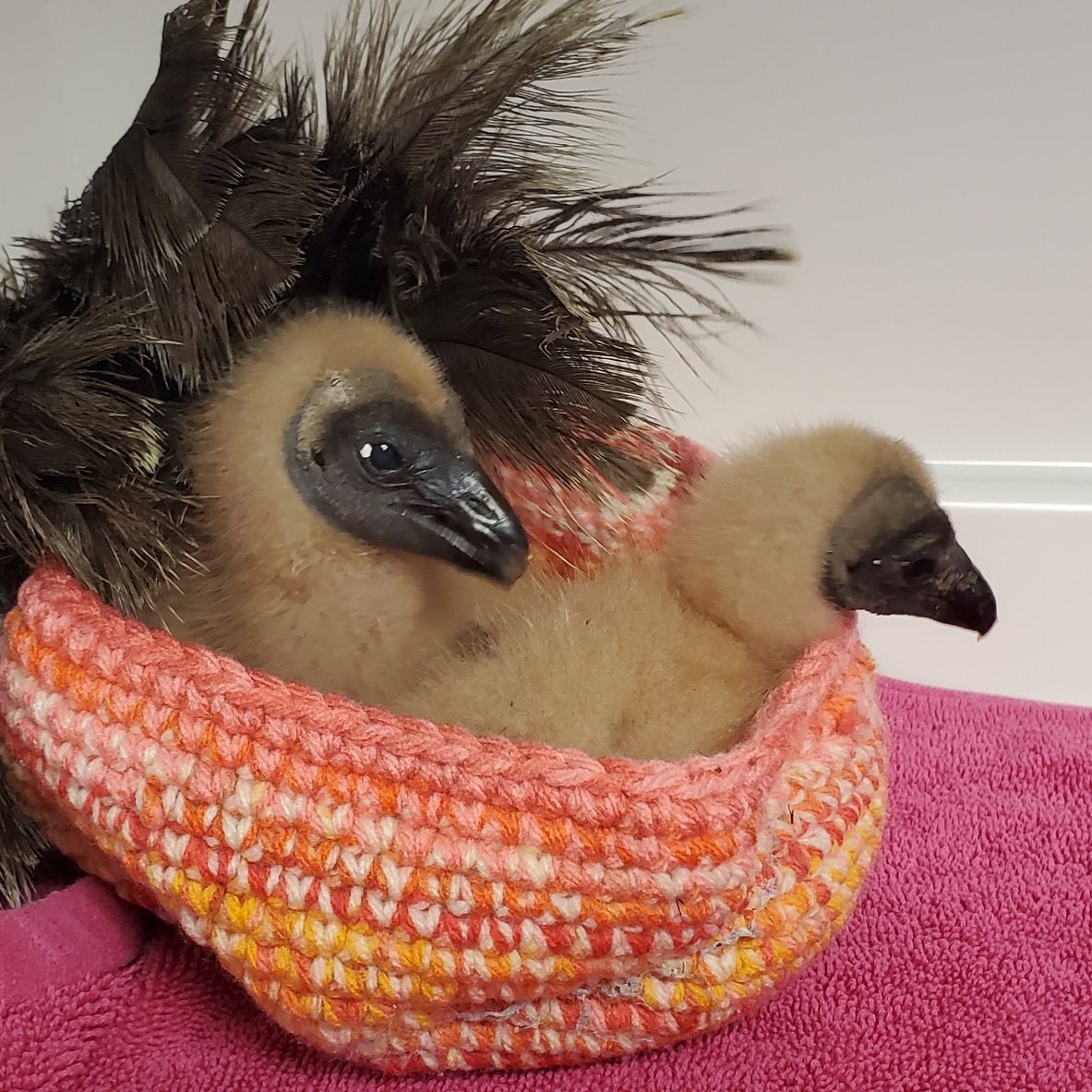
Because vultures are known “ground nesters”, they prefer to lay their eggs and raise their young in locations such as dark crevices, caves, hollow trees/fallen logs, abandoned buildings, brush piles, etc. Due to these nesting locations being significantly different than the depicted nesting behavior we see in many other birds (ie. collection of sticks, twigs, and leaves in high, out-of-reach areas), people may stumble across a clutch of young vultures and mistakenly believe they have fallen from their parents' reach. In the past, many people have “rescued” and brought in healthy, young vultures to Pelican Harbor with good intentions, but in reality are displacing these chicks from where they are supposed to be. 


Pictured above are two black vulture chicks that were brought into our clinic due to the mistaken removal from their nest

If you ever happen to run into a nest of juvenile vultures, never intervene unless absolutely necessary. Call Pelican Harbor or another wildlife rehabilitation center and see what steps to take next after finding the nest. Experts will be more than happy to assist in these situations, and will help to avoid any unnecessary disturbances!

With that being said, the next time you stumble across our large, bald, funky-looking friends chowing down on their favorite slice of roadkill, take your eyes of disgust and transform them into eyes of admiration! Instead of feeling repulsed, express gratitude to our native vultures for protecting us and our surrounding ecosystem from the harmful spread of disease. And remember, if you happen to stumble across a nest of our baby vulture friends, first call your local wildlife rehab center to help guide you through the best options based on the current situation.

References

Cats: Our Friends, Their Foes

Written by: Nicholas B. Canino, PHSS Intern

Cats are one of the most popular pets in the United States, with about 43 million households owning at least one. Their quirky personalities, neverending curiosity, and admirable features make them delightful pets to have. It is also common knowledge that these enthusiastic critters are not nearly as domesticated as dogs and still have a “wild side” to them. Much of their time is spent hunting toys on a string, pouncing on their owner’s hands, and gnawing on whatever they can get their paws on. Unfortunately, this can lead to a major issue for native animals on the receiving end of their wild nature.

Many cat owners think that it is essential to allow their cats to have free access to the outdoors around the neighborhood. This is due to a common misconception that cats require time outdoors in order to live a healthy life, but in reality, it has the opposite effect. But whether owners decide to leave them outside overnight, during the day, at all times, or even for short periods of time, these cats can do severe damage to the native wildlife that also calls that neighborhood home. Instead of having toys to hunt while inside, cats that are outdoors will choose to hunt a variety of native animals including lizards, birds, and small mammals. Many of these animals end up severely wounded or dead as a result of the cat's wild instincts.

Of course, cats are not to blame for simply complying with their natural behavior. In nature, these cats would be able to hunt and the populations of these animals would not decline so significantly. However, because of the increasing population of feral and outdoor cats in the United States, many native populations are not able to keep up. In some regions of the world, cat populations can be directly attributed to the extinction of numerous species. One study in 2013 found that domestic cats in the U.S. kill an average of 1.3 to 4 billion birds and 6.3 to 22.3 billion mammals annually. This unfathomable number of wildlife killed each year solely from domestic cat predation is why many wildlife ecologists believe cats are a greater concern for biodiversity than deforestation or climate change.

For a long time, cat owners have overlooked the impact that their precious pet is having on their local environment. Many owners will refute this argument by stating that they feed their cats a sufficient amount of food to stop them from hunting. But, has a cat ever stopped hunting toys on a string because it was full? Likewise, many owners say they have only seen their cat bring home an animal once or twice. But, for every animal they bring home, a few were left where they were killed and many more were severely injured and left to die. That is where Pelican Harbor Seabird Station comes in.

Over the past few years, Pelican Harbor has better tracked the circumstances of admission for many of our injured and sick animals. Since 2019, we have had nearly 500 animals come in that were attacked by a cat. About 75% of these animals were birds such as Northern Mockingbirds and Mourning Doves. The other 25% includes mammals like baby opossums and squirrels that we frequently get in the summer months. Cat attacks are the second most frequent reason why animals are brought to us for treatment. Unfortunately, the survival rate for these animals is very low with less than 50% of birds surviving to release. This is due to a potent bacteria that cats carry called Pasteurella multocida, which left untreated has a grace mortality  rate. Our treatment for patients attacked by cats includes strong antibiotics to avoid infection, laser treatment for pain, and wound repair and cleaning if necessary.

Because of the high occurance of cat attacks, there is a lot that we can do at Pelican Harbor to improve the situation for our native animals. Educating guests on the consequences of leaving their cats outdoors is one of the most impactful methods we can use to reduce the negative effects of outdoor cats. We always recommend that people leave their cats indoors and only allow outside access if there is an area where wildlife cannot get to, like an enclosed patio. Not only does this ensure that our wildlife is protected, but that our cats are safe as well. While we do our part to treat our wildlife, make sure you are doing your part to protect them too!


References:

Are outdoor cats happier? - Animal Humane Society

The impact of free-ranging domestic cats on wildlife of the United States - Nature