By Anika Schmid
Pelican Harbor Seabird Station’s Speaker Series “Shells, Scutes & Scales: Husbandry Care of Native Reptile Species at Frost Science” was held on February 12, 2025. The event was hosted by Helen Bradley, senior terrestrial biologist at the Phillip and Patricia Frost Museum of Science.
Bradley was a PHSS volunteer for six and a half years before joining the Frost Science team in 2022 as their herpetologist. She is now the senior terrestrial biologist, as she continues to care for the reptiles while also overseeing the birds.
Reptiles are complex, vital parts of our current ecosystem. Bradley shared lesser-known facts about reptiles and their care. She provided personal anecdotes about the native Florida reptiles she has worked with during her time at Frost.
All About Reptiles
Reptiles are cold-blooded, known as ectotherms. They need to be out in the sunshine to gain body warmth, unlike mammals and birds, which make their own body warmth. If the reptile is too hot, they need to find a shady place or burrow to cool down. These adaptations enable them to survive on far less food since they do not need the calories from food to make body heat. Reptiles are very resilient and can endure harsh conditions and extended periods without food, a trait that has contributed to their evolutionary success for over 300 million years.
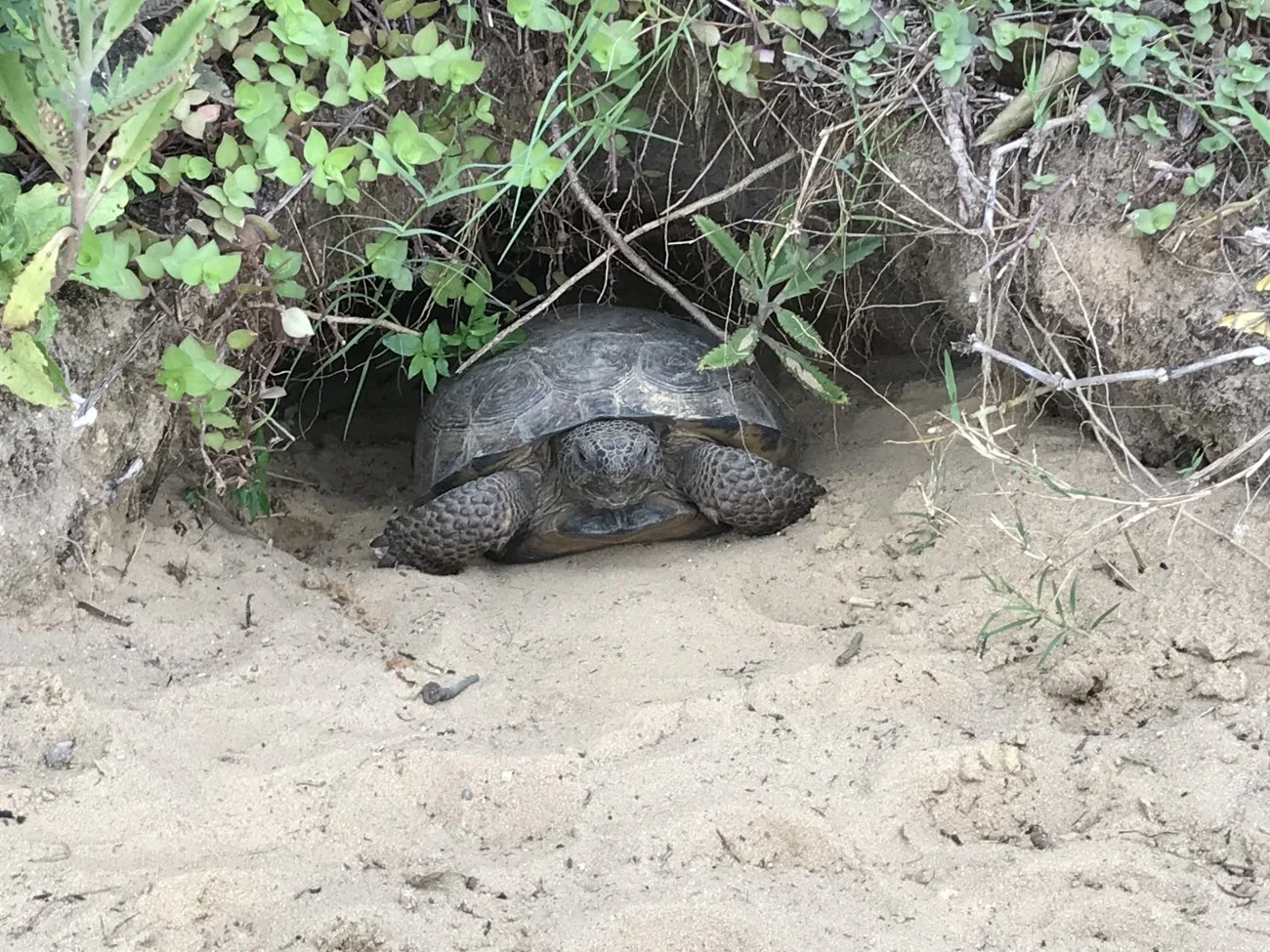
Gopher Tortoise in a burrow entrance at Merritt Island National Wildlife Refuge by James Lyon.
Gopher Tortoise
Gopher Tortoises are a keystone species, so they are a critical organism that has a disproportionately large impact on their environment. They play a critical role in maintaining the structure of an ecological community. Up to 350 species utilize the Gopher Tortoise burrow, including other reptiles. Their burrows maintain a stable temperature year-round, providing cool during hot summers and warmth during winters. Burrows can stretch over 40 feet long and about 10 feet deep.
Gopher Tortoises have strong, elephant-like back legs, while their front legs are covered in scales. Their front feet are shaped like shovels, which is great for digging burrows. They also use their legs to dig depressions in the ground to catch and drink rainwater to stay hydrated even when it is dry.
The shells of Gopher Tortoises can change color. When it is hot, their shells will lighten to reflect the heat. Their shells are darker when they are cold, allowing them to absorb more heat from the sun. This subtle shift in pigmentation helps Gopher Tortoises manage body temperature with precision.
Gopher Tortoises have a very slow metabolism, like many reptiles, which allows them to survive long periods without food or water. They primarily eat grasses, fruits, and flowers, as well as over 300 species of plants. Similar to other species, Gopher Tortoises disperse seeds in their fecal matter.
In 2024, Pelican Harbor Seabird Station treated 11 Gopher Tortoises, which are protected as a state-designated threatened species in Florida. The Florida Fish and Wildlife Conservation Commission (FWC) grants you permission to move a Gopher Tortoise if they are crossing a busy road. Put the tortoise in the same direction it was headed. Do not move the Gopher Tortoise to another location or put the tortoise in your car, since this constitutes illegal possession.
Box Turtle
A box turtle may live in the same one-mile square area. This species should never be relocated due to their small home range. Box turtles generally live for about 25 to 35 years, although some have been known to survive for over a hundred years.
Their shells are not just protective barriers; they are living regenerative structures. Box turtles can heal minor shell damage over time. They possess a hinged shell, which allows them to completely close themselves from predators by pulling all of their limbs — head, legs, and tail — into their shell. Their shell is made up of a combination of scales and bones. A box turtle’s shell includes the ribcage, and almost everything is fused together, adding to its strength.
Box turtles can travel about 55 yards a day on average. They can find their way home from strange areas as long as the turtle is not too far away. If you find a turtle on the road, pick them up and put them on the other side of the road. Always put the turtle in the same direction they were facing.
Crocodilian: Alligator and Crocodile
Crocodilians are the apex predators of the reptile world. Florida has two species: the American Alligator and the American Crocodile. South Florida is the only place in the world where both live in close proximity.
Alligators and crocodiles are often confused with each other, but there are many easy ways to tell the two apart. Alligators have a U-shaped snout while crocodiles have a V-shaped snout. Crocodiles live longer, are larger, heavier, and have a stronger bite force. Male crocodiles can grow to 20 feet. Female alligators can grow to 10 feet. Alligators stop growing between 20 and 30 years old, while crocodiles continue to grow throughout their lives. The weight of a Saltwater Crocodile’s head is 440 pounds.
Alligators and crocodiles regrow thousands of teeth throughout their lifetime. At any given time, they can have between 60 and 80 teeth. Their tongue is fused into their jaw, so they must tilt their head back to swallow their food. Crocodiles produce the strongest gastric juices known in the animal kingdom, enabling them to digest tough materials like bones, hooves, and shells of turtles.
Alligators can effortlessly stay afloat and are built for the water. Their muscular and powerful tails help them swim efficiently. Alligators have large lungs and can move their lungs further to the back of their body to help them dive. They move their lungs forward to come up out of the water.
In comparison, crocodiles have a harder time staying afloat because they are heavier and have a narrower body, making them less buoyant. They have a valve in the back of their mouth that seals the throat off from air and water. Crocodiles have a higher tolerance for lactic acid buildup in their muscles. This allows them to hold their breath for longer periods than the alligator, and crocodiles can swim more extended distances underwater.
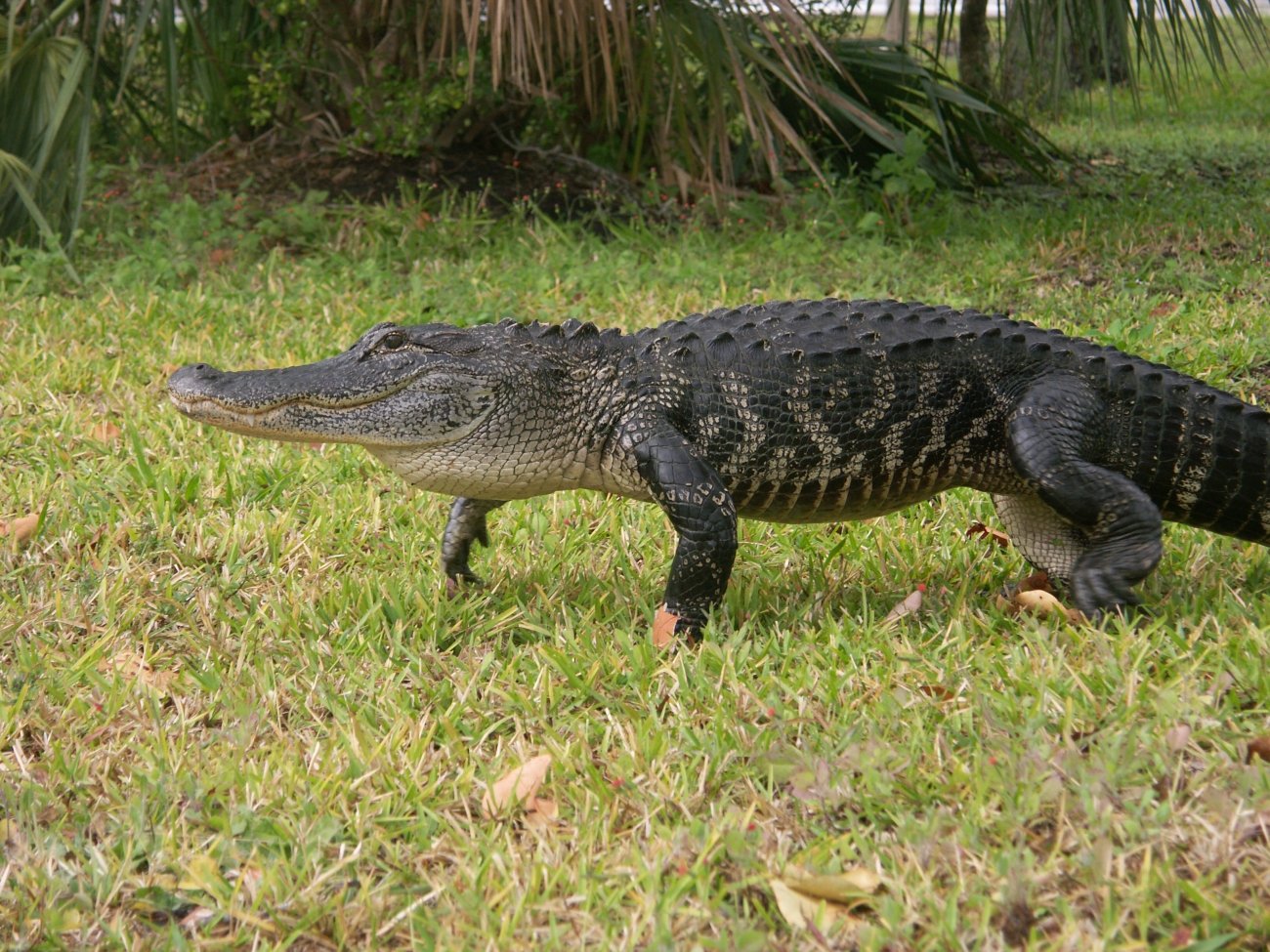
American Alligator at J. N. “Ding” Darling National Wildlife Refuge by USFWS.
Florida’s Alligators
Florida has an estimated population of 1.3 million alligators of every size. Since Florida’s human population has grown significantly, there has been an increase in waterfront homes and water-related activities. As a result, the frequency of human-alligator interactions can increase.
Please follow these safety tips from the FWC when encountering alligators.
Keep a safe distance if you see an alligator.
Never feed an alligator. This is illegal and dangerous. A fed alligator can learn to associate people with the availability of food, leading them to become a nuisance and need to be removed from the wild.
Keep pets on a leash and away from the water’s edge. Pets often resemble the natural prey of alligators.
Swim only in designated swimming areas during daylight hours. Do not swim with your pet. Alligators are most active between dusk and dawn.
If you’re concerned about an alligator, call the FWC’s toll-free Nuisance Alligator Hotline 866-FWC-GATOR (866-392-4286).
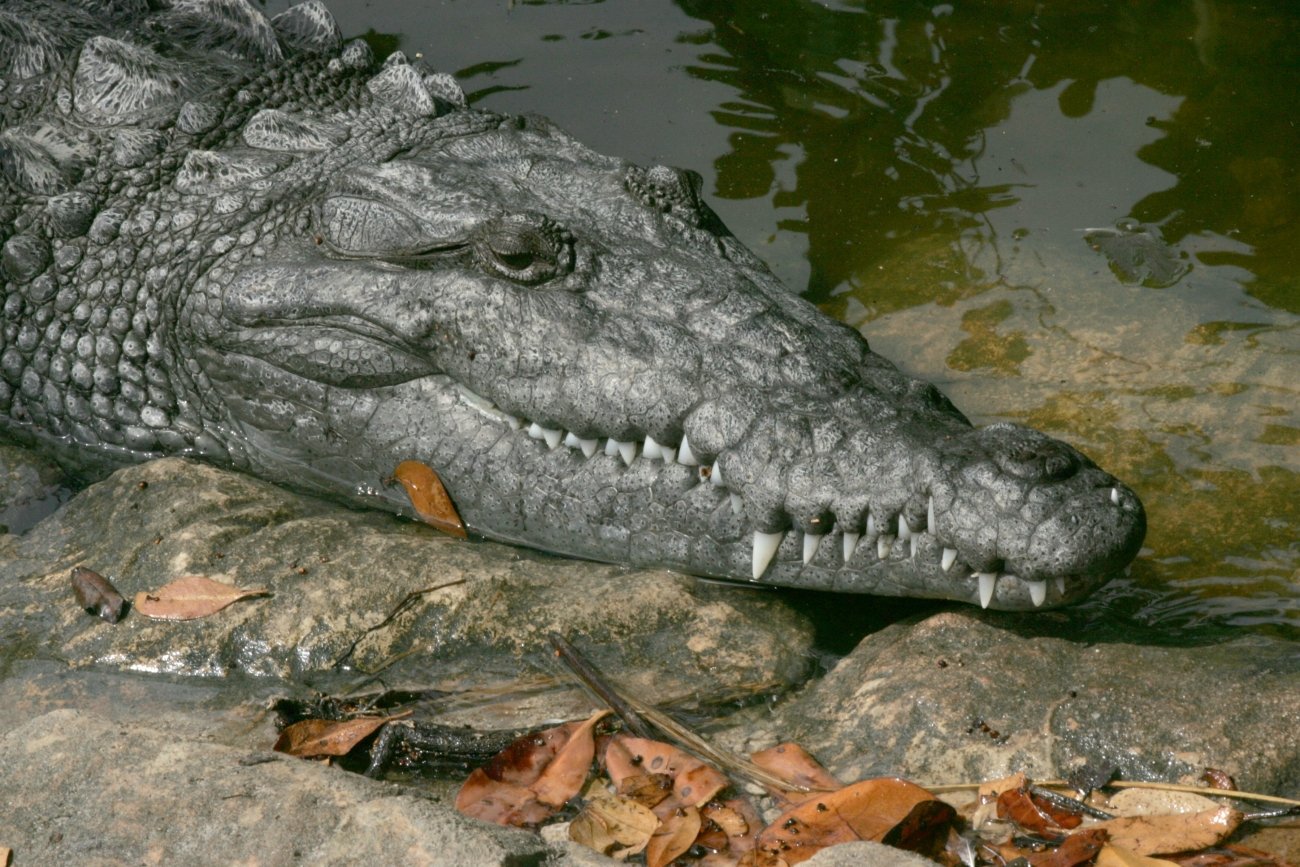
American Crocodile at Everglades National Park by Rodney Cammauf.
Florida’s Crocodiles
Florida is the only place in the United States where people can see American crocodiles in the wild. American Crocodiles were once listed as endangered in 1975, but the numbers have recovered from a few hundred to 2,000 adult crocodiles today.
The presence of a crocodile is not a reason for immediate concern. Often, it is best to leave the crocodile alone. Please follow these safety tips from the FWC when encountering crocodiles.
Leave crocodiles alone. Killing, harassing, or possessing crocodiles is prohibited by state and federal law.
Never feed crocodiles. This is illegal. Fed crocodiles may become accustomed to people and may be more likely to become a nuisance.
Keep pets a safe distance from water that may contain crocodiles. Do not allow pets to swim, exercise, or drink this water. Cats and dogs resemble the natural prey of crocodiles, so they are more susceptible to being bitten by crocodiles when in or near the water.
Separate your family and pets from crocodiles with fencing or other barriers.
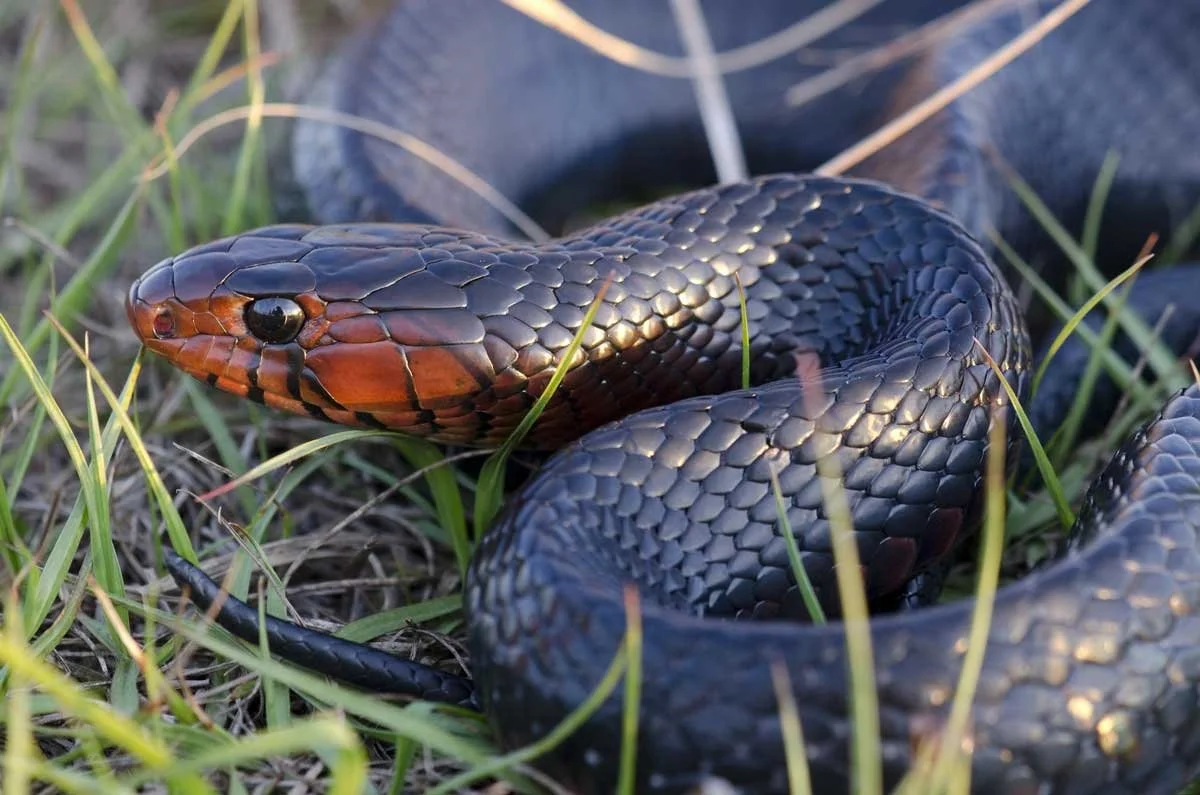
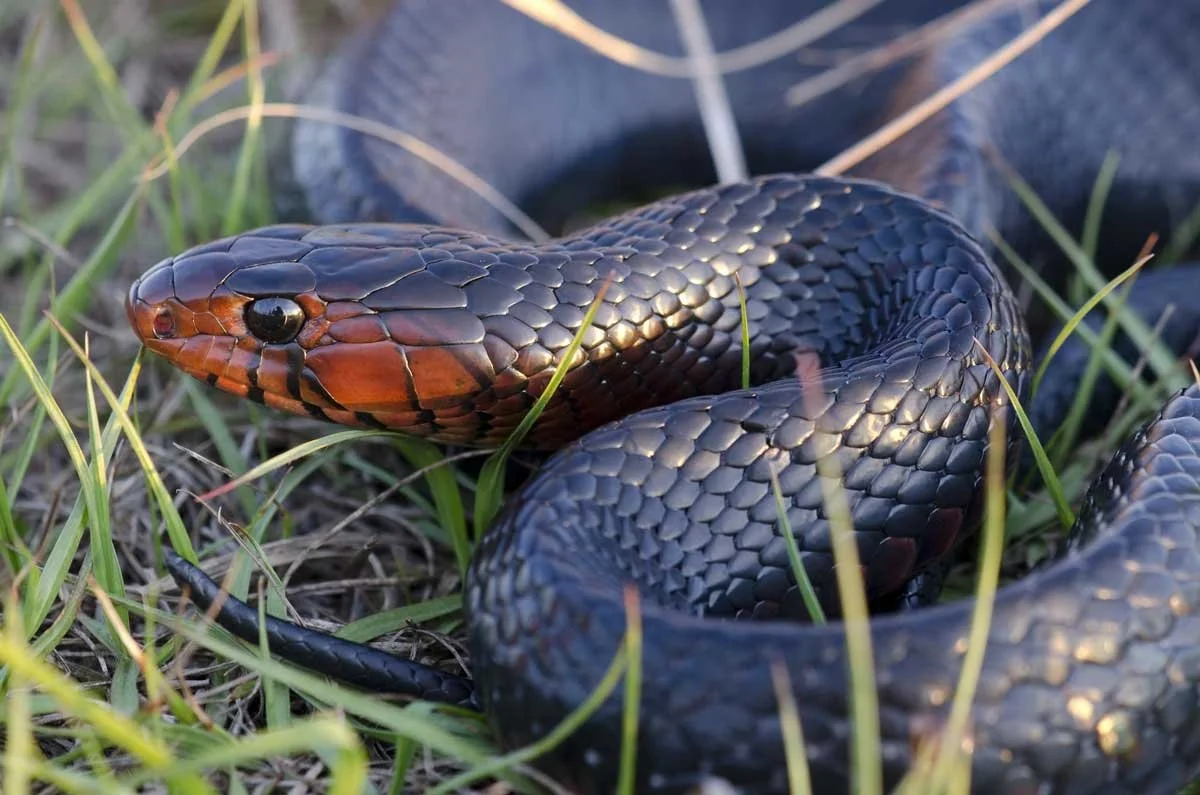
Eastern Indigo Snake in the grass by USFWS.
Eastern Indigo Snake
Eastern Indigo Snakes are the longest snake native to the United States, reaching 8 feet. They have iridescent, blue-black scales that shimmer under sunlight.
This species is non-venomous but preys on anything they can overpower, such as mammals, small birds, fish, amphibians, and even other snakes. These snakes use their large size and powerful jaws to attack and eat prey. Eastern Indigo Snakes are immune to the venom of North American Rattlesnakes.
Eastern Indigo Snakes are federally protected as a threatened species in Florida. They are vulnerable due to habitat loss, fragmentation, and the pet trade. These snakes are one of the species that utilize Gopher Tortoise burrows to shelter from rain, heat, or cold weather. Eastern Indigo Snakes fall prey to hunters looking to flush out rattlesnakes in those burrows.
FWC is looking to learn more about the Eastern Indigo Snakes, as they are a federally threatened species. Please report sightings through the Florida Rare Snake Registry for any of the following snakes: Eastern Indigo Snake, Southern Hognose Snake, Florida Pine Snake, Short-Tailed Kingsnake, or Rainbow Snake.
Identifying Snakes
There is no easy way to distinguish between non-venomous snakes and venomous snakes. Most non-venomous species have a rounded or spoon-shaped head, but there are exceptions like the venomous Coral Snake. Brown Water Snakes have a triangular head, but they are not venomous. Some Milk Snakes have a striking resemblance to the venomous Coral Snake, making them vulnerable to being killed by scared humans. Don’t rely on color-based rhymes or get close to a snake’s head to determine if it is venomous; move away from the snake.